62
10.4 Transmission Delay
Another approach for packet sorting in multi-camera operation is the so-called Transmis-
sion Delay.
Due to the fact, that the currently recorded image is stored within the camera and its
transmission starts with a predened delay, complete images can be transmitted to the
PC at once.
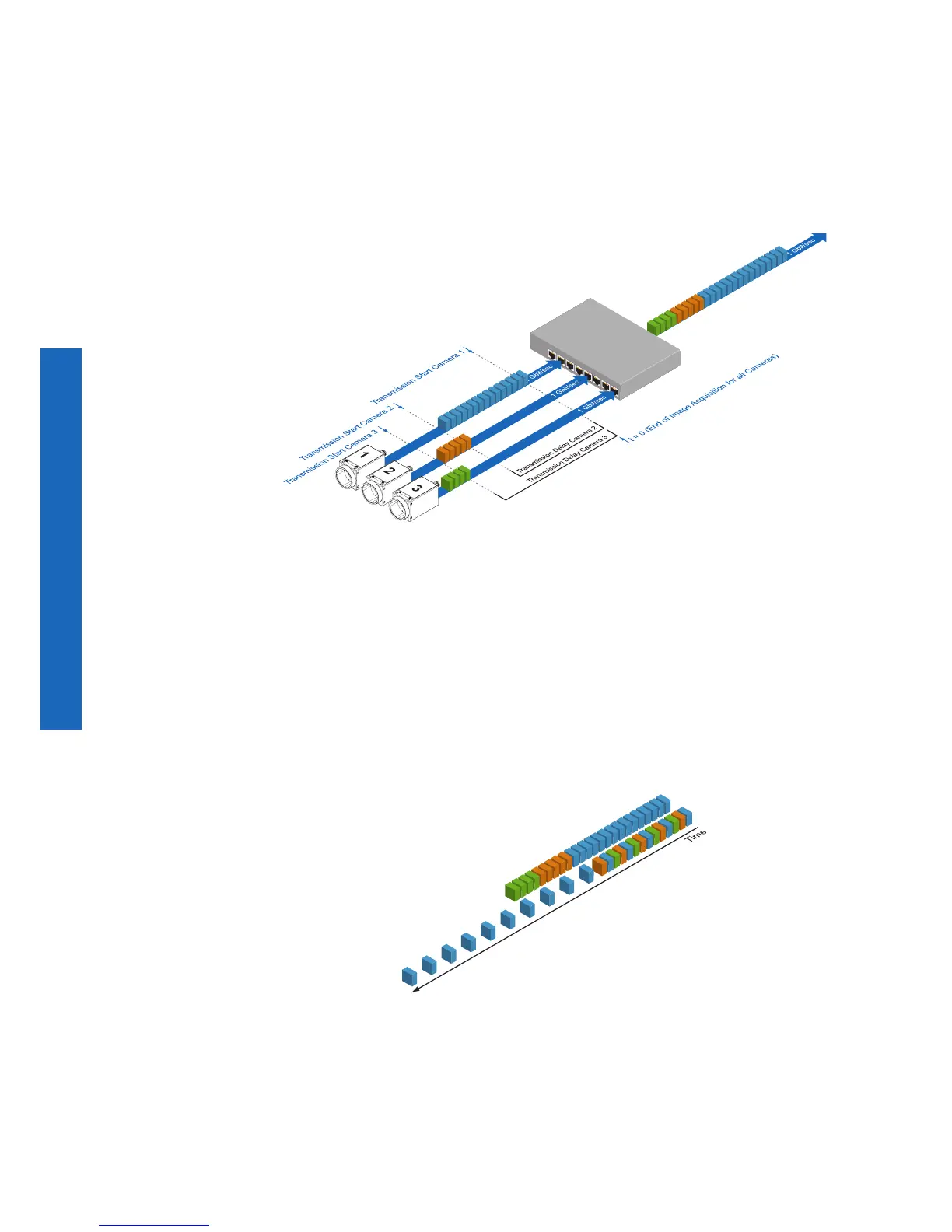
The following gure should serve as an example:
For the image processing three cameras are employed – for example camera 1: VXCG-
53M, camera 2: VXCG-53M, camera 3: VXCG-53M.
Due to process-related circumstances, the image acquisitions of all cameras end at the
same time. Now the cameras are not trying to transmit their images simultaniously, but –
according to the specied transmission delays – subsequently. Thereby the rst camera
starts the transmission immediately – with a transmission delay "0".
10.4.1 Time Saving in Multi-Camera Operation
As previously stated, the transmission delay feature was especially designed for multi-
camera operation with employment of different camera models. Just here an signicant
acceleration of the image transmission can be achieved:
For the above mentioned example, the employment of the transmission delay feature
results in a time saving – compared to the approach of using the inter packet gap – of ap-
prox. 45% (applied to the transmission of all three images).
Figure49►
Principle of the trans-
mission delay.
Figure50►
Comparison of transmission
delay and inter packet gap,
employed for a multi-camera
system with different camera
models.


 To Next Page