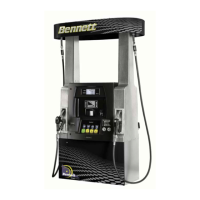
Bennett 3000 Spec 300 Series Instruction Manual Preliminary Install Information
16
UNDERGROUND AND ABOVEGROUND STORAGE TANK S
Make sure the installation for underground and aboveground storage tanks conforms to the new Environmental Protection Agency (EPA)
regulations and are in accordance with the National Fire Protection Agency NFPA 70: National Electrical Code (NEC), NFPA 30A: Code for
Motor Fuel Dispensing Facilities and Repair Garages, NFPA 30: Flammable and Combustible Liquids Code, International Fire Code (IFC),
and all state and local codes.
Follow Petroleum Equipment Institute’s Recommended Practices for Installation of Underground Liquid Storage Systems RP100 and/or
Recommended Practices for Installation of Above Ground Storage Systems for Motor Vehicle Fueling RP200. The installation must conform
to EPA, NFPA, and State regulations for storage tanks.
CAUTION: THE AIR ELIMINATOR (COPPER) TUBE MUST REMAIN OPEN TO THE ATMOSPHERE FOR PROPER
VENTILATION.
Always test new and used storage tanks prior to use. When a new dispenser is attached to an old installation, the tanks should be cleaned
and tested for leaks. Any water accumulation in the tank must be removed. Note: Tank testing should be done by a qualified professional.
Refer to the Environmental Protection Agency for Underground Storage Tank (UST) Regulations.
IMPORTANT: Bennett Pump is not responsible for any damage to the dispenser or for improper operation due to
accidents, abuse, or faulty installation. We highly recommend installing new wires in the underground
metal conduits to validate the equipment warranty.
ABOVEGROUND STORAGE TANKS
Bennett Self-Contained dispensers can be used with Aboveground Storage Tank installation if the following requirements are met.
An Underwriters (U.L.) Listed Pressure Regulating Valve designed for under-the-pump mounting is installed for each pumping
unit according to the valve manufacturer’s instructions.
Any additional valves suggested by the Pressure Regulating Valve manufacturer are installed according to the manufacturer’s
recommendations.
UNDERGROUND STORAGE TANKS
Underground Storage Tanks are installed and used must conform to EPA, NFPA, and State regulations for underground storage tanks. For
complete instructions for installing underground liquid storage systems, order “Recommended Practices for Installation of Underground
Liquid Storage Systems” from the Petroleum Equipment Institute, P.O. Box 2380, Tulsa, OK 74101 or at http://www.pei.org
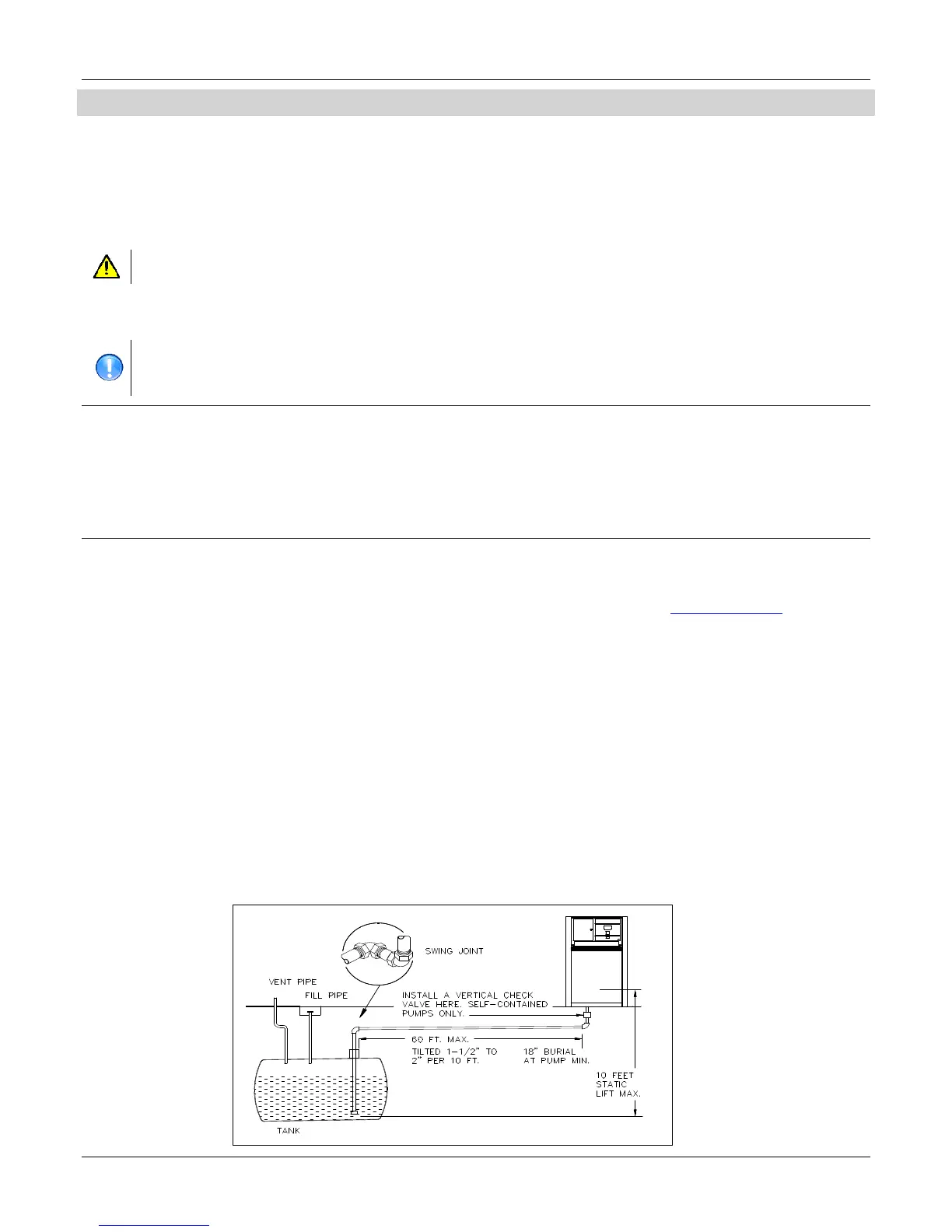
The underground storage tanks for self-contained dispensers should be as close to the dispenser as possible. In hot climates or high
altitudes, the distance should be very close to prevent vapor lock. The total length of horizontal piping between the self-contained
dispenser and the underground storage tank should be no more than 60 feet.
For Bennett Dispensers the horizontal section of pipe from the underground storage tank should be at least 18 inches below the surface
at its highest point. If not, hot summer temperatures will convert the liquid in the pipe to vapor and stop the dispenser from functioning
properly. All joints in the product line must be tight. The product line must not sag or have any high spots.
Swing joints or flex pipe must be used at the ends of the horizontal pipe between the dispenser and the tank. These joints
prevent leaks that might develop through ground movement from settling of the tank, frost heaving of the ground or pump
island settling. The joint under the dispenser also aids proper alignment of the product union or coupling.
All piping must be clean of foreign debris such as oil, grease, and shavings. All connections must be liquid tight to prevent leaks.
Flexible Connectors must be listed and labeled according to UL 2039, Standard for Flexible Connector Pipe for Fuels.
All piping shall be supported and protected against physical damage, including damage from stresses arising from settlement,
vibration, expansion, or contraction. The installation of nonmetallic piping shall be in accordance with the manufacturer’s
instructions.




 To Next Page