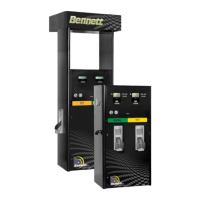
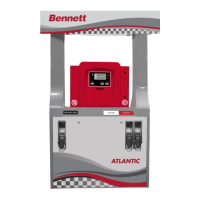
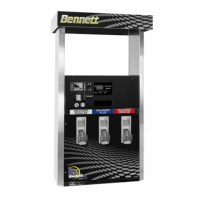
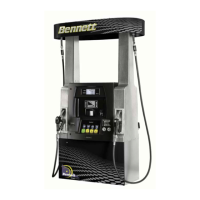
Bennett 3000 Spec 300 Series Instruction Manual Preliminary Install Information
15
SECTION 3: PRELIMINARY INSTALL INFORMATION
To ensure proper operation and to receive optimal performance of the Bennett 3000 Series Dispenser, it is highly recommended that all
local, state, and federal requirements be observed for installation of all equipment.
Compliance with these standards protects the operator and the consumer from personal injury and ensure an accurate delivery of
product. Any deviation from the use of authorized replacement parts or alteration of a designed product configuration may cause
personal injury, death or the revocation of one or all of the above approvals.
UNLOADING, UNPACKING, AND INSPECTING A NEW DISPENSER
Bennett dispensers are bolted to a pallet and then carefully packaged with cardboard/Styrofoam liners and a cardboard exterior carton.
The entire package is then securely wrapped with plastic shrink-wrap. Use a fork lift to lift the dispenser while it is still on the pallet.
Before signing the freight delivery receipt, inspect the carton and pallet for any obvious signs of damage that may have damaged the
dispenser. If any damage is found, instruct the delivery driver to make a notation on the delivery receipt before signing it. Open the
carton and inspect the dispenser before signing the delivery receipt.
Bennett dispensers are shipped Ex-Works. This means that the title to the equipment passes to the purchaser at the time the equipment
is loaded on the truck at our factory. Freight damage claims are the responsibility of the purchaser. Bennett will assist in preparing any
damage claim, by helping identify and price any parts necessary to make needed repairs.
Carefully remove the plastic shrink-wrap from the carton. Then carefully remove the cardboard container and any inside liners. DO NOT
DISCARD THE PACKAGING. Should the need arise to repackage the dispenser; the cardboard packaging can be reused. Plastic shrink-wrap
can be purchased at office supply stores or industrial packaging stores.
Examine the exterior panels for any signs of freight damage. If damage is found after signing for delivery, call the freight carrier
immediately and request an inspection. DO NOT DISCARD THE PACKAGING; the inspector will want to examine it.
Once you are sure that there is no freight damage to the exterior of the dispenser, use the door key (wire tied to the nozzle hook) to
unlock the lower door. Remove the lower door from both sides of the dispenser. Visually examine the interior of the dispenser for
shipping damage. While the dispenser is extremely sturdy, a dispenser that has been “dropped” can suffer damage internally even while
it appears normal on the exterior.
Read the model/serial plate of the dispenser and check to confirm that the hydraulic configuration matches the order specified. Report
any non-shipping related problems to Bennett Customer Service by mail, facsimile, telephone or e-mail at the locations specified below:
REQUIRED EQUIPMENT AND MATERIALS
The following items are recommended for proper installation of Bennett Dispensers.
Anchor Bolts
Any additional installation equipment and/or tools required for hanging hardware, nozzles, hoses, valance, etc.
Continuity Tester
Lift Straps
Lifting device to lift and transport the dispenser.
Multipurpose Tool
Multi-Tester
Personal Barriers
Pipes & Tubes Refer to your dispenser Footprint for actual pipe and tube sizes
Pliers (e.g. Lineman’s, Needle-Nose)
Potting Compound National Fire Protection Agency NFPA 70: National Electrical Code (NEC) approved.
Screwdrivers (e.g. Phillips®, Standard Flat Head) in various sizes
Sealant that is UL approved for use with compressed natural gas systems.
Voltmeter
Wiring Tools (i.e multipurpose tool, wire nuts, wire stripper, etc.)
When installing units that contain a high alcohol product (e.g. E100). Confirm that the plumbing is designed to handle an alternative fuel.
For multi-hose units, piping must align with the footprint.
Alternative fuels, such as E25, E85, and other ethanol blends, may require special piping materials or components. Consult the piping
manufacturer to determine if the piping material, fittings, and connectors are compatible with the alcohol-blended fluid being used.



 To Next Page