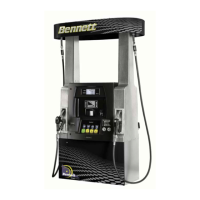
Bennett 3000 Spec 300 Series Instruction Manual Dispenser Operation
35
HOW TO PURGE PRODUCT LINES FOR SUCTION SYSTEMS
The Suction pump product lines must be purged of all air that may be trapped in the lines. All electrical connections must be made and
verified at this time.
The pumping unit evacuates all the air in the pipe before it gets to the meter. The air is expelled through the vent at the top of the
pumping unit. Nothing but fuel should pass through the meter. The meter will not turn until fuel enters the pump and pressurizes the
system.
WARNING: TAKE APPROPRIATE MEASURES TO CONTAIN ANY PRODUCT EMERGING FROM THE AIR ELIMINATION CHAMBER
TUBE. DISPOSE OF ANY SPILLED PRODUCT IN PROPER MANNER CONSISTENT WITH APPLICABLE LAWS AND
CODES.
CAUTION: THE AIR ELIMINATOR (COPPER) TUBE MUST REMAIN OPEN TO THE ATMOSPHERE FOR PROPER VENTILATION.
CAUTION: DO NOT RUN PUMPING UNITS FOR MORE THAN 5 MINUTES WITHOUT LUBRICATION OR DAMAGE TO THE UNIT
CAN OCCUR. TO AVOID DAMAGE TO PUMPING UNITS RUNNING MORE THAN 5 MINUTES, ADD A QUART OF OIL
IN THE AIR ELIMINATOR FOR LUBRICATION. REFER TO PRIMING THE PUMPING UNIT SECTION BELOW.
PRIMING THE PUMPING UNIT
Under normal circumstances, fuel is present before 5 minutes of pumping but if fuel is not present, the pumping unit MUST be primed.
Prime the pumping unit using the Air Eliminator Vent or the Drain Plug located on the strainer cover to pour product into the pumping
unit to prevent the pumping unit from running dry.
Use a test prover can or other appropriate approved container to dispense 50 gallons or 175 liters through the pump. Begin dispensing by
only slightly opening the nozzle to allow any entrapped air in the dispenser to slowly release through the air eliminator. This prevents
over-speeding of the meter.
Once the pump has dispensed 50 gallons of fuel, the SB100 meter should be tested for calibration.
HOW TO PERFORM THE CALIBRATION PROCEDURE
Enter into Manager’s Mode 27 and slide the (E-Cal) switch to the right on the 719 CPU Board to gain access. If you attempt to dispense
with this switch in E-Cal Mode, the dispenser will give you an Error.
THE BASIC CALIBRATION PROCEDURE
The basic calibration procedure assumes that the test can sight glass is graduated in units of cubic inches or cubic centimeters (milliliters).
If the sight glass is in test can percentage units, refer to The Optional Calibration Procedure.
Prior to performing any E-Cal procedure, you must go to Mode 6 and make sure the dispenser configuration is correct. An incorrect
configuration will prevent the use of un-configured meters. You also must make sure that every product has a price other than zero. A
zero price will prevent the use of any configured meter.
1. Press the number 2 and 7, then the Mode button on the keypad. The first display shows the current electronic calibration correction
constant of the first configured meter. Use the ↑ button to view the current electronic calibration correction constant for each
configured meter. Once you are viewing the desired meter, press Enter.
2. The main display shows the test can size entry prompt. Enter the test can size and press the Enter button. Once the test can size has
been entered, the main display for the select dispenser side will show READY and the test can size will appear in the first PPV
display. The second PPV display if applicable will show the volume unit of measure (USG for United States Gallon or LIT for Liter).
3. At this point, you are ready to run a test can sale. Turn on the pump handle. Once the product is selected, the main volume display
will reset. The main money display will show the current electronic calibration correction constant for the selected meter. The
volume display will show the current sale volume.
4. Run a sale as close as possible to the test can size entered in step 2 and turn off the pump handle. The display will change to the
error entry display.
5. Depending on the volume unit of measure, the error display will either show In Err for cubic inches or cc Err for cubic centimeters
(milliliters). Enter the amount of the error (positive or negative) and press the Enter button. You can only change the amount to a
negative value after the entered amount is other than zero. Once the Enter key is pressed, the main display will show READY. Go to
step 3 to run another test can until all meters are calibrated or press Cancel to exit.
6. If calibration is complete, move the calibration switch back to the operate position and seal it.



 To Next Page