III. SPECIFICATIONS, CONNECTIONS & USER INTERFACE cont’d.
11
1111
11
C
CC
C-
--
- MANUAL CONTROLS AND CONNECTIONS
MANUAL CONTROLS AND CONNECTIONS MANUAL CONTROLS AND CONNECTIONS
MANUAL CONTROLS AND CONNECTIONS
1
11
1-
--
- FRONT OF VENTILATOR
FRONT OF VENTILATOR FRONT OF VENTILATOR
FRONT OF VENTILATOR
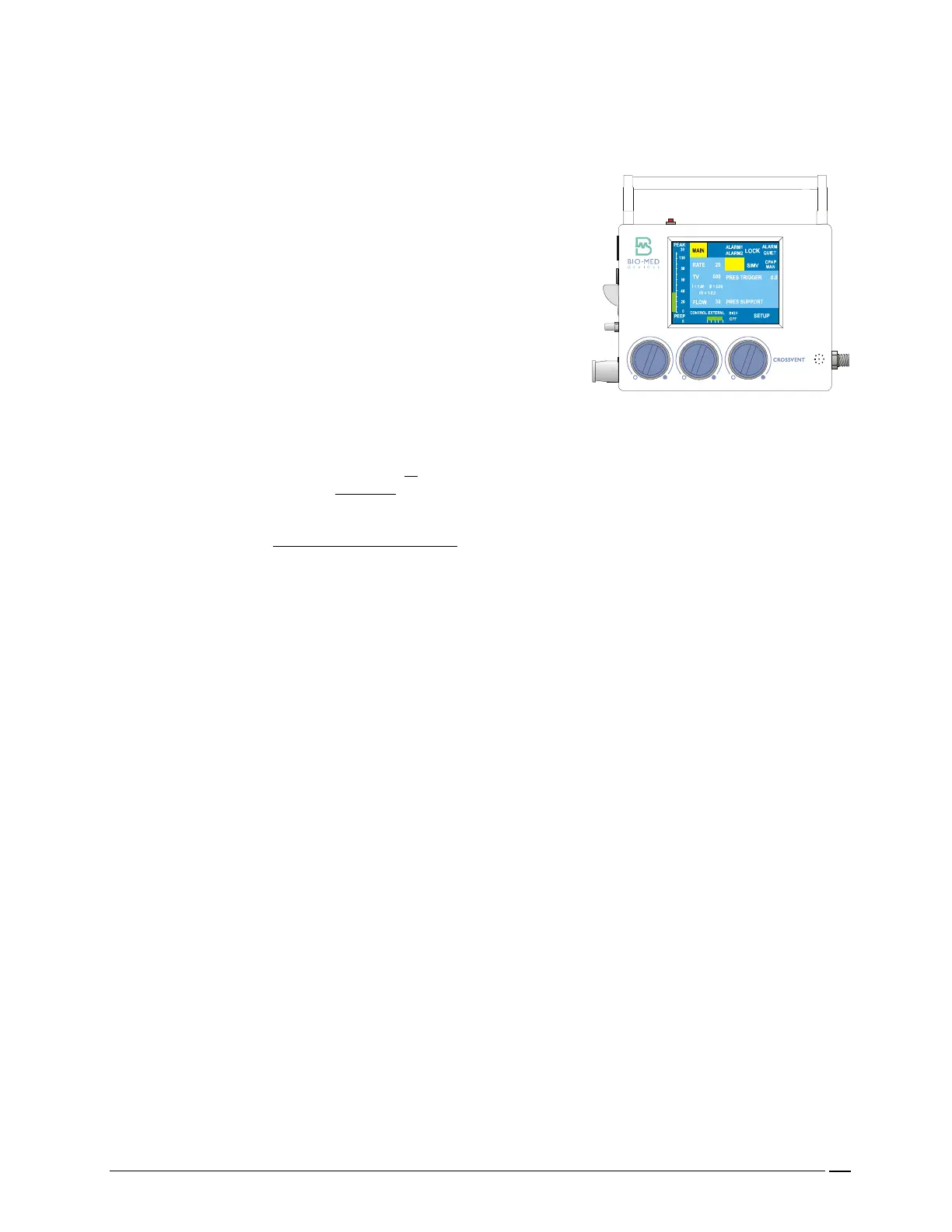
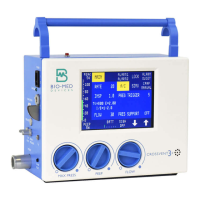
FLOW CONTROL KNOB
FLOW CONTROL KNOBFLOW CONTROL KNOB
FLOW CONTROL KNOB
Adjusting this knob sets the inspiratory flow from 0 - 120 lpm. The
Flow setting is displayed in the FLOW key on the display. It is
accurate from 1 to 120 lpm.
WARNING: In rare instances, when using the
Crossvent with an air/oxygen blender, there may be a
reduction in the delivered flow at the higher flow
settings. This reduction may occur when the blender is
set below 30% or above 90% O
2
and the Crossvent is set
to flows above 80 lpm. Lower supply pressures to the
blender will tend to decrease the flow further so be sure
these supply pressures are maintained at 45- 75 PSI
(310-517 kPa). If the Crossvent has the exhaled
tidal volume monitoring feature, it is
recommended this be used to ensure proper tidal
volumes are being delivered. If it does not have this feature, then an external
spirometer is recommended.
NOTE: With the optional entrainment on
, flow accuracy from 5 - 100 LPM is ±10% or 1 LPM, whichever
is greater, and with a flow of 100 LPM
and over, flow accuracy is within 15% of displayed flow. No accuracy
is claimed below 5 LPM.
When air entrainment is on, verify the message “ENTRN” is displayed in the Inspiratory Source Key.
Set the FLOW after entrainment is turned on
since the flow calibration is automatically adjusted for
entrainment. It is not recommended that entrainment be turned on or off while ventilating. However, if this
should become necessary, then it should be done during the expiratory phase of the breathing cycle. Be aware
that this will change the flow.
MAXIMUM PRESSURE KNO
MAXIMUM PRESSURE KNOMAXIMUM PRESSURE KNO
MAXIMUM PRESSURE KNOB
BB
B
Adjusting this knob sets the pressure applied to the exhalation valve and to an internal adjustable relief
valve. This determines the maximum pressure during assisted and controlled inspirations. It is adjustable
from 0 - 120 cmH
2
O. It should always be operative and properly adjusted.
NOTE: While connected to an active gas source, the Maximum Pressure control should be turned off (fully
counter clockwise) when the Crossvent is not in use to conserve gas.
PEEP KNOB
PEEP KNOBPEEP KNOB
PEEP KNOB
(Positive End Expiratory Pressure)- Adjusting this knob sets the PEEP or CPAP (Continuous Positive
Airway Pressure) level applied to the exhalation valve. It is adjustable from 0- 35 cmH
2
O. The PEEP level
is determined by observing the system pressure bar graph or with the PEEP/CPAP readout on the
secondary alarm menu.
NOTE: The Maximum Pressure should always be set higher than PEEP in order to achieve the PEEP
setting.
NOTE: While connected to an active gas source, the PEEP control should be turned off (fully counter
clockwise) when the Crossvent is not in use to conserve gas.
AUDIBLE ALARM
AUDIBLE ALARMAUDIBLE ALARM
AUDIBLE ALARM
Located next to the BMD logo on the front of the unit, it emits the audible tones to indicate an alarm
condition or keyboard actuation.
WARNING: It should never be obstructed.
NOTE: Refer to Appendix E for all the beeper codes.
ALARM
ALARM ALARM
ALARM LED
LEDLED
LED
This flashes on and off in equal duration during any alarm providing 360-degree visibility. When unit is
turned off or loses power, it flashes for 3 minutes. This time may be less if the Crossvent was not powered
on for at least 1 minute prior to loss of power.
FIG. 1- FRONT VIEW
A/C
OFF
+
3
FLOWMAX PRESS PE EP


 To Next Page