III. SPECIFICATIONS, CONNECTIONS & USER INTERFACE cont’d.
12
1212
12
2
22
2-
--
- RIGHT SIDE OF VENTILATOR
RIGHT SIDE OF VENTILATOR RIGHT SIDE OF VENTILATOR
RIGHT SIDE OF VENTILATOR
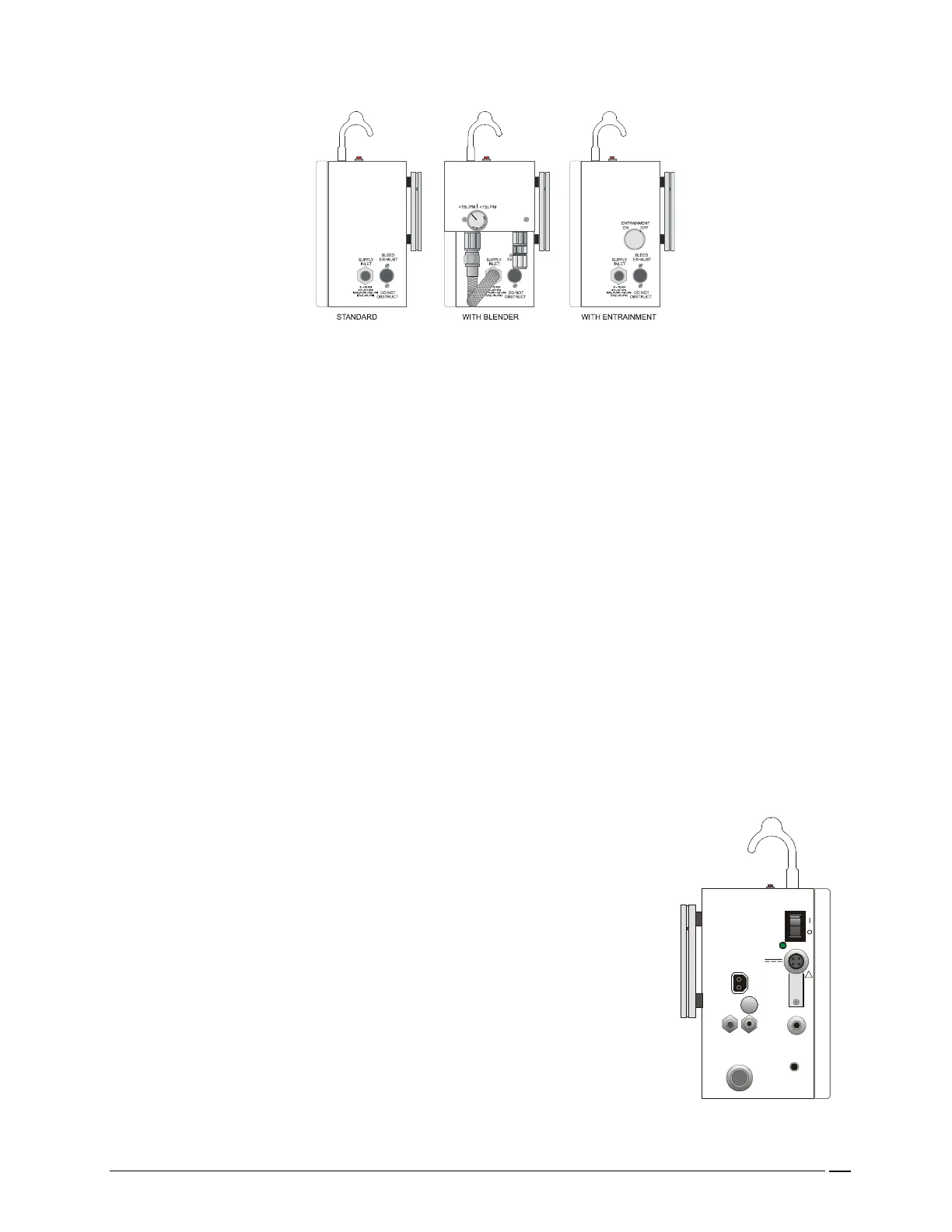
FIG. 2- RIGHT SIDE VIEWS
CAUTION:
Antistatic or electrically conductive hoses or tubing should not be used.
GAS SUPPLY INLET
GAS SUPPLY INLETGAS SUPPLY INLET
GAS SUPPLY INLET
Male DISS 9/16-18 fitting. Clean, dry, medical grade gas, delivered at 31 to 75 psi (214 – 517 kPa) pressure
at 132 lpm is required. These requirements apply to the inlet of the ventilator in order to ensure proper
flows. If the supply pressure falls below 31 psi, an internal sensor will detect this and the Crossvent will
alarm. A serviceable 40-micron filter is contained within the supply fitting.
GAS SUPPLY WITH BLEN
GAS SUPPLY WITH BLENGAS SUPPLY WITH BLEN
GAS SUPPLY WITH BLENDER
DERDER
DER
When using a blender, oxygen and air supplies are connected to the blender and the output of the blender is
then connected to the Crossvent Supply Inlet. For optimum performance, 45 – 75 PSI (310 – 517 kPa)
should be supplied to the blender. Oxygen concentrations set by the blender are then delivered to the
patient. Refer to the Blender Operation Manual for instruction on its use.
GAS SUPPLY WITH ENTR
GAS SUPPLY WITH ENTRGAS SUPPLY WITH ENTR
GAS SUPPLY WITH ENTRAINMENT
AINMENTAINMENT
AINMENT
When equipped with the optional Air Entrainment Module, the CROSSVENT is able to supply either 100%
or 50% (nominal) oxygen during transport, without the use of compressed air. A unique feature of the
entrainment system is the ability to deliver repeatable volumes during volume limited ventilation, with
relatively constant oxygen concentration.
When using entrainment, the source gas should be 100% O
2
. When the air entrainment control on the right
side of the CROSSVENT is turned to the ON position, a sophisticated, multiple venturi system is activated,
which draws in ambient air and dilutes the 100% O2 supply gas to a nominal 50% concentration.
An additional advantage of using entrainment is that the oxygen supply consumption will be reduced,
thereby increasing the operating time on a given supply of gas.
When entrainment is off, the gas delivered is the same as is connected to the supply inlet.
WARNING: Operation of the Crossvent in a contaminated environment can be
hazardous when entrainment is used.
BLEED EXHAUST
BLEED EXHAUSTBLEED EXHAUST
BLEED EXHAUST
Internal bleeds from the pneumatic controls exhaust through this screened port.
This area must not be obstructed when the ventilator is in use.
3
33
3-
--
- LEFT SIDE OF VENTILATOR
LEFT SIDE OF VENTILATOR LEFT SIDE OF VENTILATOR
LEFT SIDE OF VENTILATOR
POWER ON/OFF SWITCH
POWER ON/OFF SWITCHPOWER ON/OFF SWITCH
POWER ON/OFF SWITCH
It is located on the left side of the unit and is recessed in order to reduce
inadvertent or unauthorized use. It controls the main power to the electronics.
If the battery is allowed to fall below 6 volts (well below the Low Battery alarm
limit) with the unit operating, the ventilator will turn off independently of this
switch. If this occurs, this switch must be turned to OFF before the ventilator
will operate again, regardless of power source.
WARNING: Never use the On/Off switch to silence the alarms
since this renders the alarms permanently disabled.
FIG. 3- LEFT SID
POWER
ON
OFF
EXH
VALVE
AIRWAY
PRESSURE
NEBULIZER
PATIENT
ALARM
RESET
O
2
!
FLOW SENSOR
CHARGING


 To Next Page