Percutaneous Lead Placement in the Epidural Space
Clinician Manual
97035873-01 23 of 75
Innion CX Lead Placement in the Epidural Space with Entrada Needle
1. Position, prep and drape the patient in the usual accepted manner. Inject a local anesthetic at the needle
insertion site.
2. Verify that the Entrada needle is fully assembled by holding onto the sheath hub and applying forward
pressure on the stylet cap cover.
CAUTION: Do not bend the Entrada needle. Bending the Entrada needle may cause the stylet or LOR
adapter to become jammed in the needle assembly and difcult to remove.
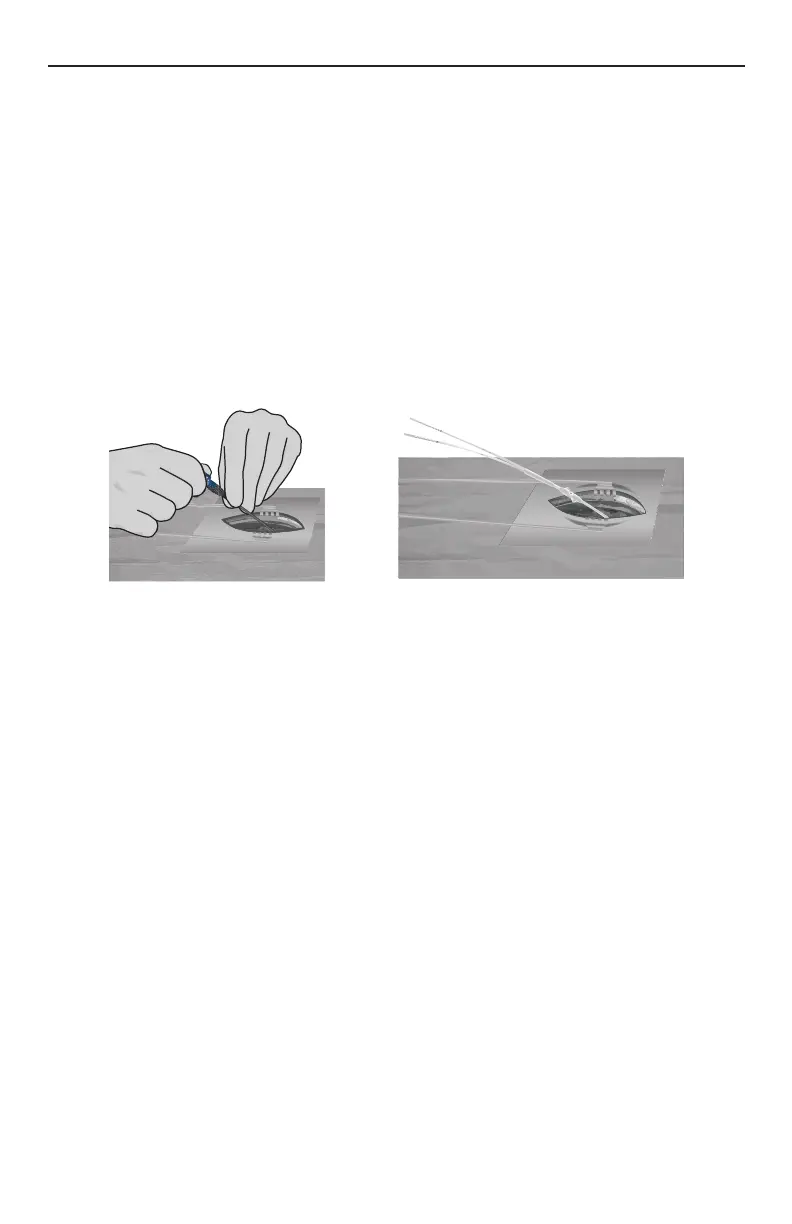
3. Recommended for permanent or permanent-trial procedures: Cut down prior to inserting the Entrada
Needle and insert needle into incision. Creating the incision before inserting the Entrada Needle provides
a clear path for sliding the anchor into the incision.
If cutting down after inserting the Entrada Needle, ensure that the sheath is in place and do not damage
the sheath.
4. Under uoroscopic guidance, place the Entrada Needle into the epidural space with the 14G marking
facing up using an angle of 45° or less.
CAUTION: Use only an Entrada Needle provided by Boston Scientic. Other needles may damage the
lead. Turning the bevel ventral (down) may result in lead damage. An angle of more than 45° increases
the risk of lead damage.
WARNING: The angle of the insertion needle should be 45° or less. Steep angles increase the insertion
force of the stylet and also present more of an opportunity for the stylet to pierce the lead and cause
tissue damage.
Note: If the needle must be repositioned during this procedure, or if the sheath becomes damaged,
reassemble the needle outside of the body with a new sheath, see “Assembling and
Reassembling the Entrada Needle” on page 22.



 To Next Page