Section 4: Maintenance
4.1 General
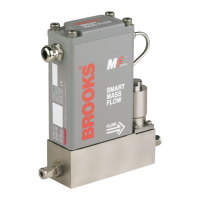
No routine maintenance is required on the MF-series Smart Mass Flow
Meters and Controllers other than occasional cleaning. The in-line lter should
periodically be replaced or ultrasonically cleaned.
NOTE: If recalibration is required, but the necessary expertise or equipment is
not available, the instrument should be returned to the factory.
4.2 Troubleshooting
System checks
The MF-series Smart Mass Flow Meters and Controllers are generally used as
a component in gas handling systems, which can be complex in nature. It can
therefore be very difcult to isolate a malfunction in the system. An incorrectly
diagnosed malfunction can cause many hours of unnecessary downtime. If
possible, perform the following system checks before removing a suspect
Mass Flow Meter or controller for bench troubleshooting or return to the
factory (especially if the system is new):
1. Verify a low resistance common connection and that the correct power
supply voltage and signals are present of the connector of the MF-series
Smart TMF.
2. Verify that the process gas connections have been made correctly, and that
they have been tested for leaks.
3. If the mass ow controller appears to be functioning but cannot achieve Set
point, verify that there is sufcient inlet pressure and pressure drop at the
controller to provide the required ow.
4. Verify that all user-selectable jumpers and switches have been set to the
appropriate positions. Refer to Figure 2-4 and table 2-4.
NOTE: If it becomes necessary to remove the instrument from the system
after exposure to toxic, pyrophoric, ammable or corrosive gas, purge
the instrument thoroughly with a dry inert gas such as nitrogen before
disconnecting the gas connections. Failure to correctly purge the instrument
could result in re, explosion or death. The MF-series Smart Mass Flow device
may also become corroded or contaminated upon exposure to air.


 To Next Page