Operation
- 3.8 - SMART KNIT
The suggested values for different yarns are as hereafter indicated:
Very thick yarns
1
Thick yarns
3
Medium yarns
5
Fine yarns (single filament yarn)
6-8
Very fine yarns
(Lycra®)
9-10
Reaction time
(DELAY)
The DELAY parameter allows the adjustment of the sensor to the characteristics of
yarn to be processed (e.g. elasticity), by defining the Reaction Time of the sensor
before signaling a defect. It is possible to program 8 pre-set values:
5 ms - 10 ms - 20 ms - 50 ms - 100 ms - 200 ms - 500 ms - 1000 ms
# 50 ms is the suggested value for very high running speed of the yarn.
# 200 ms is the suggested value for normal yarns.
# 500 ms is the suggested value for elastic yarns.
Start Frequency
(F_START)
This parameter indicates the minimum frequency of image variation, beyond
which the sensor signals that the yarn is running normally (green LED ON).
It can be programmed to a value ranging between 1 and 10.
Stop Frequency
(F_STOP)
This parameter indicates the minimum frequency of image variation, below which
the sensor signals that the yarn runs normally (red LED ON).
It can be programmed to a value ranging between 1 and 10.
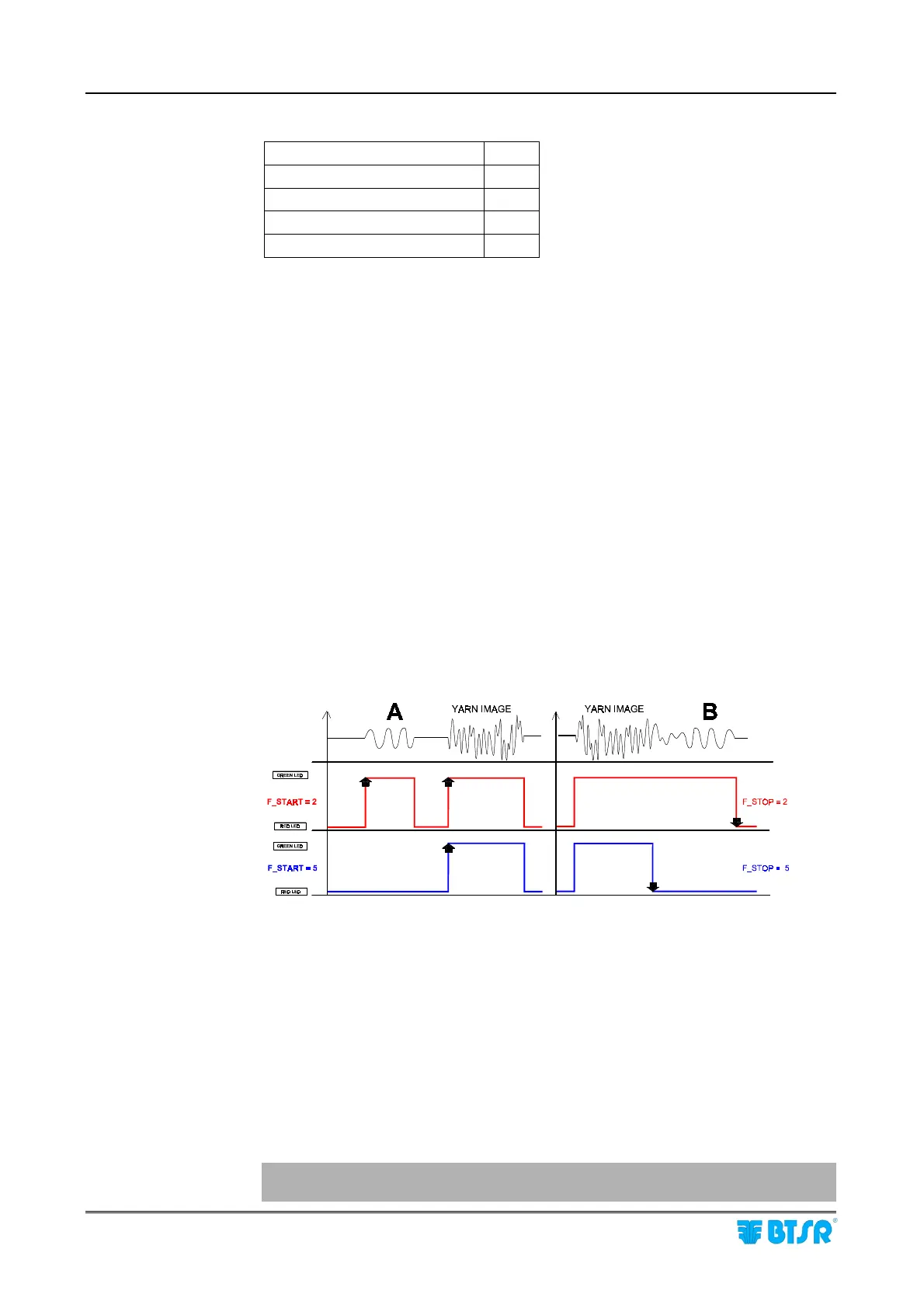
Programming examples for F_START/F_STOP and relevant sensor delays
As the diagram shows, if the F_START and F_STOP value is set low (e.g. = 2),
then the sensor could detect the condition of “running yarn” even though the yarn
is actually still or broken, and is undergoing a light oscillation (A and B areas of
the diagram). Otherwise, if a higher value is set (e.g. = 5) then the image variation
of A and B areas is not considered sufficient to detect the condition of “running
yarn”. It must be observed, however, that if the yarn detected by the sensor has a
very regular profile (e.g. Lycra® or single filament yarn), the frequency of the
image variation is lower; therefore if a value too high is programmed, the sensor
could not detect the “running yarn” condition (or it would detect it with excessive
delay). This is why the F_START and F_STOP values can be “calibrated”
according to the article to be processed, in order to obtain the condition of optimal
detection for that particular article.
!
In the presence of frequent errors detected by the sensors, it is suggested to
gradually change such values until an optimal condition is achieved.



 To Next Page