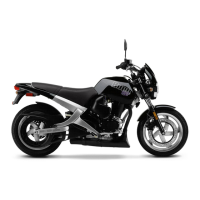
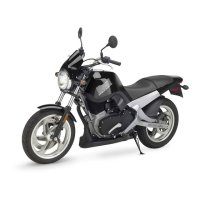
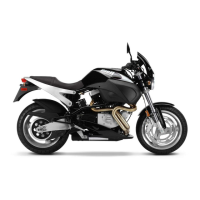
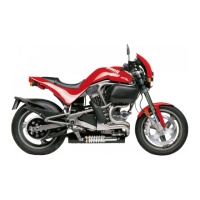
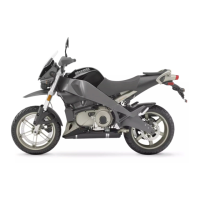
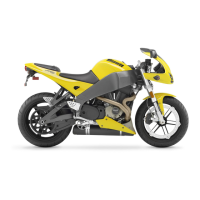
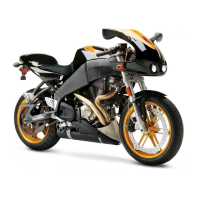
This document is a service manual for the 2003 Buell P3 motorcycle, part number 99492-03Y. It provides comprehensive information for maintenance, repair, and troubleshooting of the motorcycle's various systems.
General Device Description
The Buell P3 is a single-cylinder, air-cooled, four-stroke motorcycle with a 9.2:1 compression ratio. It has a bore of 3.50 inches (88.8 mm) and a stroke of 3.125 inches (79.375 mm), resulting in an engine displacement of 30 cubic inches (492 cc). The engine oil capacity with a filter change is 2.0 quarts (1.89 liters). The motorcycle features a five-speed constant-mesh transmission.
Important Technical Specifications
Chassis:
- Wheel Base: 55.30 inches (1404 mm)
- Seat Height: Low Seat 25.50 inches (648 mm), High Seat 27.50 inches (698 mm)
- Road Clearance: 5.10 inches (129.5 mm)
- Trail: 3.4 inches (86 mm)
- Rake: 25°
- Wet Weight: 380 lbs (172 kg)
- GVWR: 780 lbs (353 kg)
- GAWR Front: 280 lbs (127 kg)
- GAWR Rear: 500 lbs (226 kg)
- Load Capacity: 400 lbs (181 kg)
- Fuel Tank Capacity: Total (including reserve) 2.8 gallons (10.60 liters), Reserve 0.55 gallons (2.08 liters)
- Transmission/Primary Fluid Capacity: 32.0 ounces (946.0 ml)
- Front Fork Oil Capacity (each-wet): 9.2 ounces (272.0 ml)
Tire Specifications:
- Front (Dunlop 100/80 16 50s K330): Solo riding 28 psi (193 kPa), Rider & passenger 32 psi (220 kPa)
- Rear (Dunlop 120/80 16 60s K330): Solo riding 30 psi (207 kPa), Rider & passenger 36 psi (248 kPa)
- Rim Size: Front MT 2.5 x 16.0 DOT, Rear MT 2.75 x 16.0 DOT
- Rim Valve Hole Diameter: 0.33 inches (8.38 mm)
- Maximum Lateral Runout: 0.040 inches (1.02 mm)
- Maximum Radial Runout: 0.030 inches (0.76 mm)
Engine:
- Ignition Timing Advance: 1° BTDC (during engine cranking), 20° BTDC (at 1200 RPM)
- Regular Idle Speed: 1200 RPM
- Fast Idle Speed: 2000 RPM
- Spark Plug: 10R12A, 12 mm size, 0.038-0.043 inches (0.97-1.09 mm) gap, 11-18 ft-lbs (15-24.4 Nm) torque.
- Oil Pressure: 7-12 PSI (48-83 KPa) at 1000 RPM, 10-17 PSI (69-117 KPa) at 2500 RPM.
Electrical System:
- Battery: 12 VDC/12AH/200CCA, Sealed type.
- Alternator AC Voltage Output: 19-26 VAC per 1000 engine RPM
- Alternator Stator Coil Resistance: 0.2-0.4 Ohms
- Voltage Regulator Output: 14.3-14.7 VDC at 75°F, 22 Amps at 3600 RPM
- Spark Plug Cable Resistance: 2,375-5,833 ohms
- Main Circuit Breaker: 30 Amperes
- Fuses: Ignition 7.5A, Light 15A, Accessory 7.5A, System 15A, Key Switch 15A.
- Bulbs: Headlamp 60/55 Watts (5.0/4.58 Amps), Marker lamps Tail/Stop Lamp 5/21 Watts (0.42/1.75 Amps), Turn Signal Lamp (Front and Rear) 10 Watts (0.83 Amps).
Usage Features
- Fuel: Requires good quality unleaded gasoline with 87 pump octane or higher (R+M)/2. The manual warns against using gasoline containing methanol.
- Starting: The starter/ignition interlock system requires the clutch to be disengaged, transmission in neutral, or sidestand retracted for the engine to start.
- Throttle Position Sensor (TPS): Determines spark advance curves based on throttle position. The TPS voltage should be 0.5V +/- 0.05V at closed throttle and not exceed 3.7V at wide open throttle.
- Auto-Enrichener: Automatically increases idle speed and richens the fuel mixture during cold starts, typically for 2-5 minutes.
- Ignition/Headlamp Key Switch: A four-position switch (OFF, LOCK, PARK, IGN). The key is removable in OFF, LOCK, and PARK positions. In PARK, lights remain on.
- Speedometer: Electronic, displays odometer (up to 999999.9 miles) and trip odometer (up to 9999.9 miles). Features self-diagnostic capabilities with various trouble codes.
Maintenance Features
- Regular Maintenance Intervals: Detailed tables outline service operations at various odometer readings (e.g., 1000 mi, 2500 mi, 5000 mi, etc.). These include changing engine oil and filter, inspecting air cleaner, checking clutch adjustment, changing transmission/primary fluid, inspecting brake pads and rotors, checking tire pressure, lubricating steering head bearings, and more.
- Fluid Requirements: Specific types and part numbers for brake fluid (D.O.T. 4), front fork oil (TYPE E), engine oil (Harley-Davidson 20W50 or certified diesel oils), and primary drive/transmission fluid (SPORT-TRANS FLUID) are provided.
- Torque Values: Extensive tables list critical fastener torque values in both in-lbs/ft-lbs and Nm for various components, including engine, chassis, and electrical systems. Loctite application is often specified.
- Body Panel Care: Instructions for washing, polishing, and minor scratch removal for molded-in-color body panels, emphasizing the use of specific Harley-Davidson products and cautioning against abrasive materials.
- Battery Care: Safety warnings for handling and charging the sealed, maintenance-free battery. Instructions for disconnection, removal, installation, cleaning, and charging.
- Tire Maintenance: Guidelines for tire inflation, tread inspection, and replacement. Warnings against overinflation and using non-specified tires.
- Brake System: Procedures for checking fluid levels, bleeding brakes, and inspecting pads and rotors. Warnings against mixing brake fluid types and operating with faulty brakes.
- Engine Lubrication: Hot check procedure for engine oil level and recommendations for oil change intervals based on operating conditions.
- Crankcase Breathing System: Description of the system and recommendations for draining the crankcase breather drain hose at each oil change.
- Tool List: An appendix provides a list of specialized tools required for service, including part numbers and illustrations. Examples include sprocket locking tools, wheel bearing remover/installer, cylinder compression gauge, valve guide hone, and various crimping tools.
- Troubleshooting Guides: Detailed diagnostic charts and tables for various systems (e.g., fuel system, starter, ignition, charging, indicators) to help identify and resolve problems.

 Need help?
 General

 To Next Page