EasyManua.ls Logo

Canon EOS 50 E - Page 46

Canon EOS 50 E
207 pages
Print Icon
To Next Page IconTo Next Page
To Previous Page IconTo Previous Page
Loading...
Part
2:
Technical Information
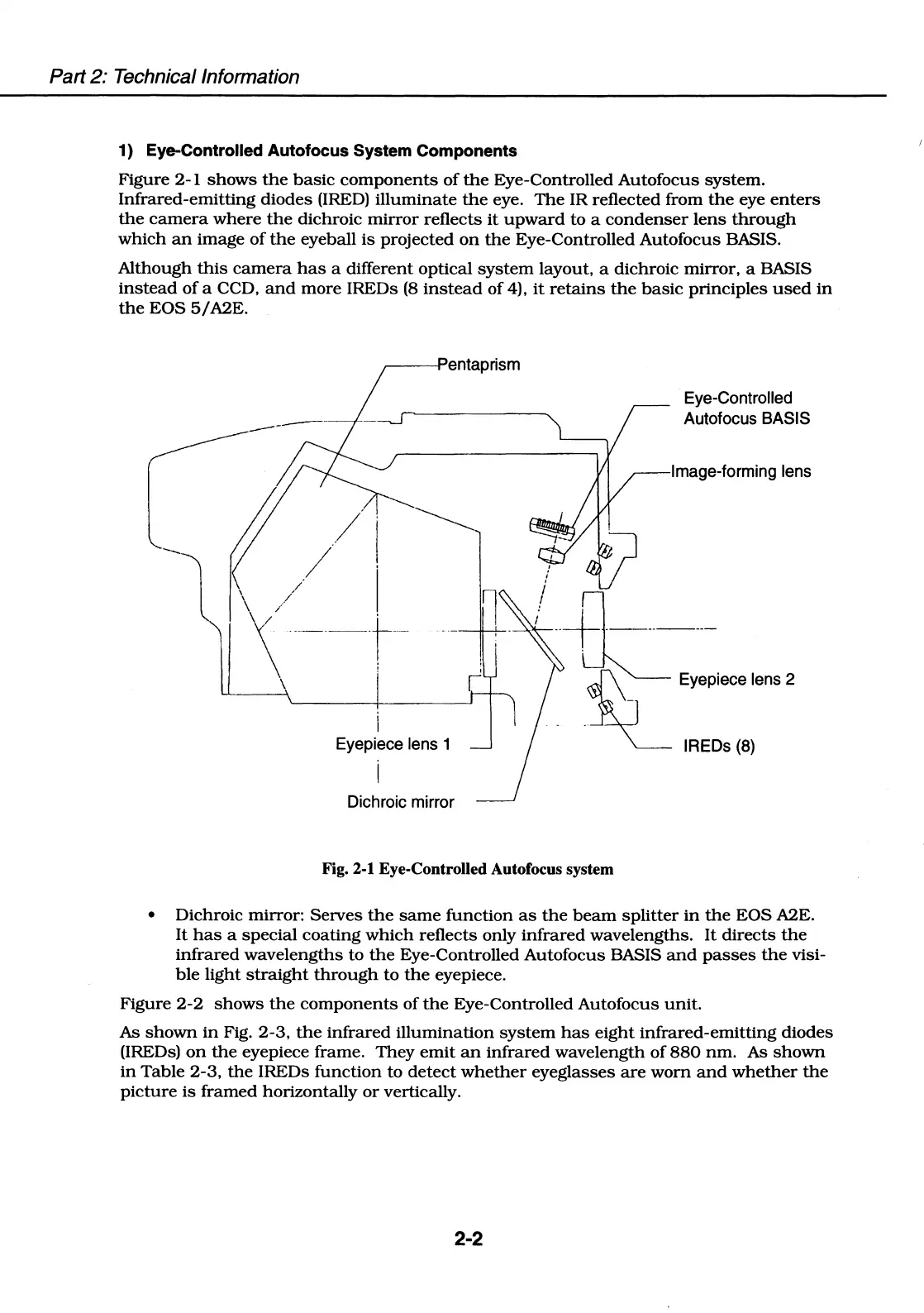
1) Eye-Controlled Autofocus System Components
Figure
2-1
shows
the
basic
components
of
the
Eye-Controlled
Autofocus
system.
Infrared-emitting
diodes
(IRED)
illuminate
the
eye.
The
IR reflected from
the
eye
enters
the
camera
where
the
dichroic
mirror
reflects
it
upward
to
a
condenser
lens
through
which
an
image
of
the
eyeball
is
projected
on
the
Eye-Controlled
Autofocus
BASIS.
Although
this
camera
has
a different
optical
system
layout,
a
dichroic
mirror,
a BASIS
instead
of
a CCD,
and
more
IREDs
(8
instead
of
4).
it
retains
the
basic
principles
used
in
the
EOS
5 / A2E.
~--r•entaprism
Eyepiece lens 1
Dichroic mirror
Fig. 2-1 Eye-Controlled Autofocus system
Eye-Controlled
Autofocus BASIS
Image-forming lens
IREDs
(8)
Dichroic
mirror:
Serves
the
same
function
as
the
beam
splitter
in
the
EOS
A2E.
It
has
a
special
coating
which
reflects only
infrared
wavelengths.
It
directs
the
infrared
wavelengths
to
the
Eye-Controlled
Autofocus
BASIS
and
passes
the
visi-
ble
light
straight
through
to
the
eyepiece.
Figure
2-2
shows
the
components
of
the
Eye-Controlled
Autofocus
unit.
As
shown
in
Fig.
2-3,
the
infrared
illumination
system
has
eight
infrared-emitting
diodes
(IREDs)
on
the
eyepiece frame.
They
emit
an
infrared
wavelength
of
880
nm.
As
shown
in
Table
2-3,
the
IREDs
function
to
detect
whether
eyeglasses
are
worn
and
whether
the
picture
is
framed
horizontally
or
vertically.
2-2

Table of Contents

Related product manuals