EasyManua.ls Logo

Canon EOS 50 E - Built-In Flash

Canon EOS 50 E
207 pages
Print Icon
To Next Page IconTo Next Page
To Previous Page IconTo Previous Page
Loading...
2.1
O Built-in Flash
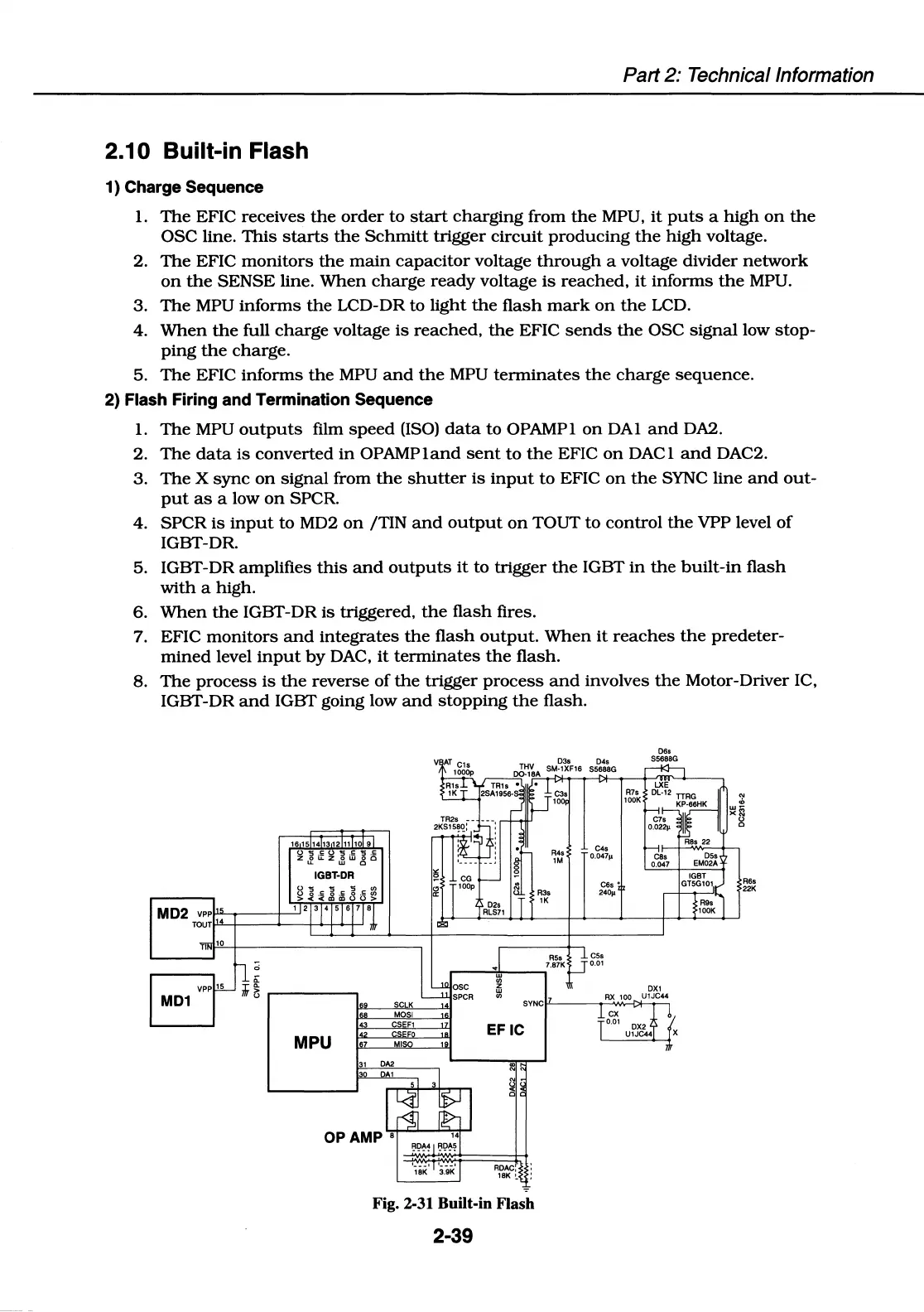
1) Charge Sequence
Part 2: Technical Information
1.
The
EFIC receives
the
order
to
start
charging
from
the
MPU,
it
puts
a
high
on
the
OSC line.
This
starts
the
Schmitt
trigger
circuit
producing
the
high
voltage.
2.
The
EFIC
monitors
the
main
capacitor
voltage
through
a voltage divider
network
on
the
SENSE
line.
When
charge
ready
voltage
is
reached,
it
informs
the
MPU.
3.
The
MPU
informs
the
LCD-DR
to
light
the
flash
mark
on
the
LCD.
4.
When
the
full
charge
voltage
is
reached,
the
EFIC
sends
the
OSC
signal
low
stop-
ping
the
charge.
5.
The
EFIC
informs
the
MPU
and
the
MPU
terminates
the
charge
sequence.
2) Flash Firing and Termination Sequence
1.
The
MPU
outputs
film
speed
(ISO)
data
to
OPAMPl
on
DAI
and
DA2.
2.
The
data
is
converted
in
OPAMPland
sent
to
the
EFIC
on
DAC 1
and
DAC2.
3.
The
X
sync
on
signal
from
the
shutter
is
input
to
EFIC
on
the
SYNC line
and
out-
put
as
a low
on
SPCR.
4.
SPCR
is
input
to
MD2
on
/TIN
and
output
on
TOUT
to
control
the
VPP level
of
IGBT-DR.
5. IGBT-DR amplifies
this
and
outputs
it
to
trigger
the
IGBT
in
the
built-in
flash
with
a high.
6.
When
the
IGBT-DR
is
triggered,
the
flash
fires.
7. EFIC
monitors
and
integrates
the
flash
output.
When
it
reaches
the
predeter-
mined
level
input
by
DAC,
it
terminates
the
flash.
8.
The
process
is
the
reverse
of
the
trigger
process
and
involves
the
Motor-Driver IC,
IGBT-DR
and
IGBT going low
and
stopping
the
flash.
MD1
VPP 15
i/,
MPU
w
<I)
ffi
<I)
R5s
7.87K
cs,
0.01
D6s
S5688G
DX1
SYNCl-'-
7
--~,,,,,.,_-c,u_,~JC~
44
EFIC
OP
AMP•
Fig. 2-31 Built-in Flash
2-39

Table of Contents

Related product manuals