Part
2:
Technical Information
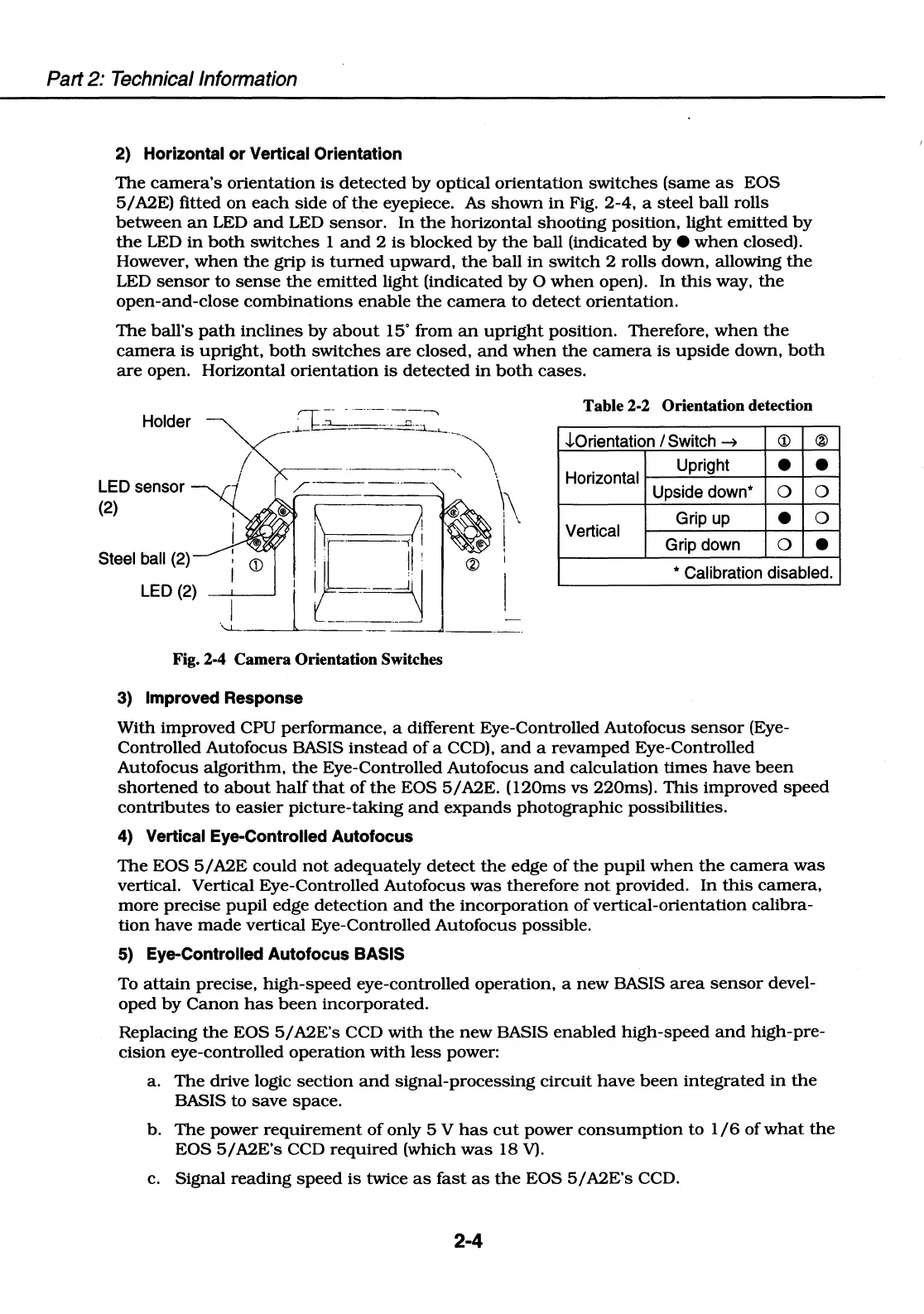
2) Horizontal or Vertical Orientation
The
camera's
orientation
is
detected
by
optical
orientation
switches
(same
as
EOS
5/A2E) fitted
on
each
side
of
the
eyepiece.
As
shown
in
Fig. 2-4. a steel
ball
rolls
between
an
LED
and
LED
sensor.
In
the
horizontal
shooting
position, light
emitted
by
the
LED
in
both
switches
1
and
2
is
blocked
by
the
ball
(indicated
by•
when
closed).
However,
when
the
grip
is
turned
upward,
the
ball
in
switch
2 rolls down, allowing
the
LED
sensor
to
sense
the
emitted
light (indicated
by
O
when
open). In
this
way,
the
open-and-close
combinations
enable
the
camera
to
detect
orientation.
The
ball's
path
inclines
by
about
15'
from
an
upright
position. Therefore,
when
the
camera
is
upright,
both
switches
are
closed,
and
when
the
camera
is
upside
down,
both
are
open. Horizontal
orientation
is
detected
in
both
cases.
Table 2-2 Orientation detection
Holder
.!Orientation / Switch
➔
(!) @
Upright
•
•
Horizontal
LED sensor
(2)
Upside down*
0 0
Vertical
Grip up
•
0
Grip down 0
•
Steel ball (2)
LED (2)
* Calibration disabled.
Fig. 2-4 Camera Orientation Switches
3) Improved Response
With improved CPU
performance,
a different Eye-Controlled Autofocus
sensor
(Eye-
Controlled Autofocus BASIS
instead
of
a CCD),
and
a
revamped
Eye-Controlled
Autofocus algorithm,
the
Eye-Controlled Autofocus
and
calculation
times
have
been
shortened
to
about
half
that
of
the
EOS
5/A2E.
(120ms
vs
220ms).
This
improved
speed
contributes
to
easier
picture-taking
and
expands
photographic
possibilities.
4) Vertical Eye-Controlled Autofocus
The
EOS
5 / A2E
could
not
adequately
detect
the
edge
of
the
pupil
when
the
camera
was
vertical. Vertical Eye-Controlled Autofocus
was
therefore
not
provided.
In
this
camera,
more
precise
pupil
edge
detection
and
the
incorporation
of
vertical-orientation calibra-
tion
have
made
vertical Eye-Controlled Autofocus possible.
5) Eye-Controlled Autofocus BASIS
To
attain
precise,
high-speed
eye-controlled operation, a
new
BASIS
area
sensor
devel-
oped
by
Canon
has
been
incorporated.
Replacing
the
EOS
5/
A2E's CCD
with
the
new
BASIS
enabled
high-speed
and
high-pre-
cision eye-controlled
operation
with
less
power:
a.
The
drive logic
section
and
signal-processing
circuit
have
been
integrated
in
the
BASIS to
save
space.
b.
The
power
requirement
of
only 5 V
has
cut
power
consumption
to
1/6
of
what
the
EOS
5/A2E's
CCD
required
(which
was
18 V).
c.
Signal
reading
speed
is
twice
as
fast
as
the
EOS
5/
A2E's CCD.
2-4







 To Next Page