EasyManua.ls Logo

Canon EOS 50 E - Page 51

Canon EOS 50 E
207 pages
Print Icon
To Next Page IconTo Next Page
To Previous Page IconTo Previous Page
Loading...
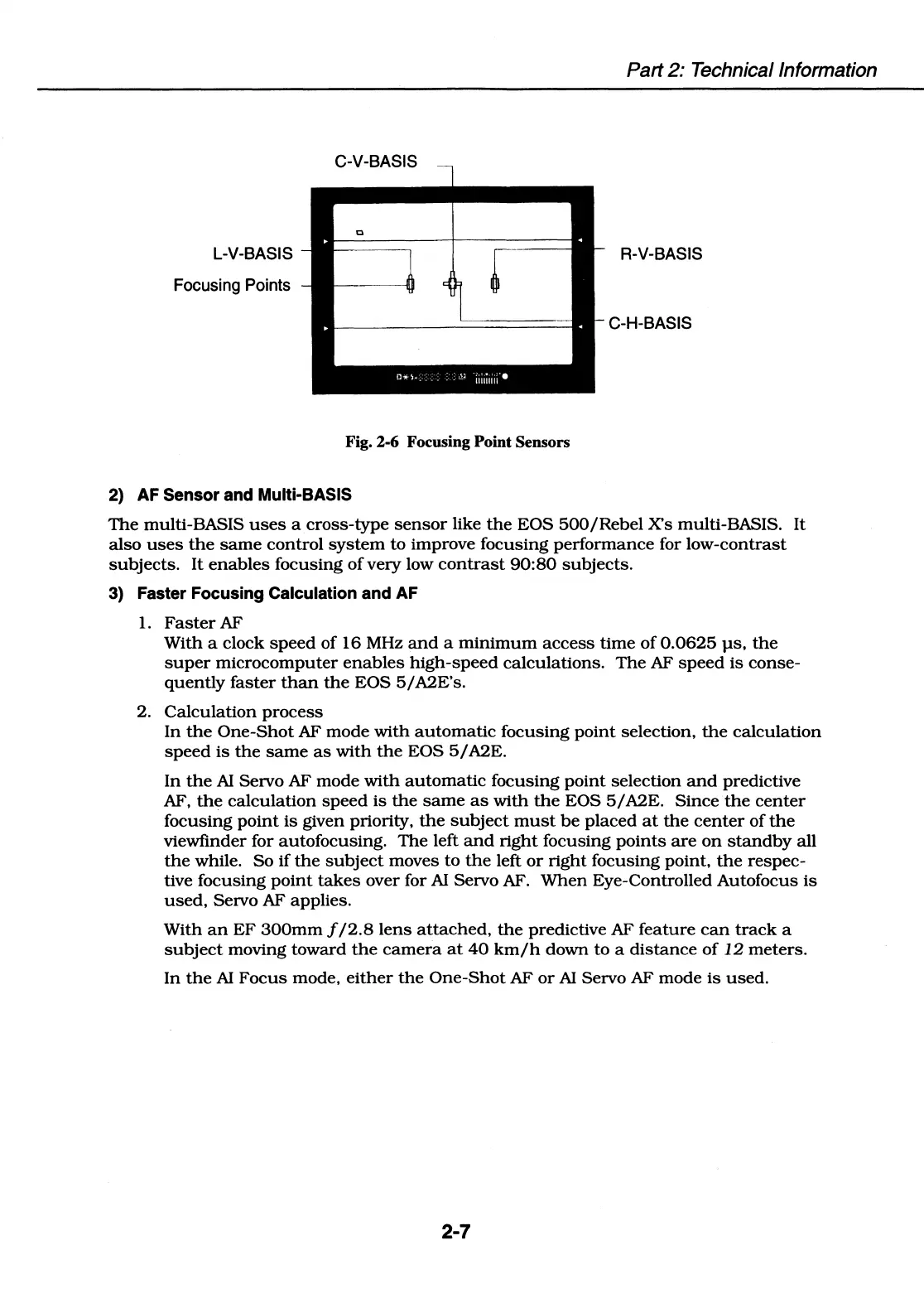
L-V-BASIS
Focusing Points
C-V-BASIS _
Fig. 2-6 Focusing Point Sensors
2)
AF
Sensor and Multi-BASIS
Part 2: Technical Information
R-V-BASIS
C-H-BASIS
The
multi-BASIS
uses
a
cross-type
sensor
like
the
EOS
500/Rebel
X's multi-BASIS.
It
also
uses
the
same
control
system
to
improve focusing
performance
for
low-contrast
subjects.
It
enables
focusing
of
very
low
contrast
90:80
subjects.
3) Faster Focusing Calculation and
AF
1.
Faster
AF
With
a clock
speed
of
16
MHz
and
a
minimum
access
time
of
0.0625
µs,
the
super
microcomputer
enables
high-speed
calculations.
The
AF
speed
is
conse-
quently
faster
than
the
EOS
5/A2E's.
2.
Calculation
process
In
the
One-Shot
AF
mode
with
automatic
focusing
point
selection,
the
calculation
speed
is
the
same
as
with
the
EOS 5 / A2E.
In
the
AI
Servo AF
mode
with
automatic
focusing
point
selection
and
predictive
AF,
the
calculation
speed
is
the
same
as
with
the
EOS
5/
A2E.
Since
the
center
focusing
point
is
given priority,
the
subject
must
be
placed
at
the
center
of
the
viewfinder for
autofocusing.
The
left
and
right
focusing
points
are
on
standby
all
the
while.
So
if
the
subject
moves
to
the
left
or
right
focusing
point,
the
respec-
tive
focusing
point
takes
over for
AI
Servo AF.
When
Eye-Controlled Autofocus
is
used,
Servo AF applies.
With
an
EF
300mm
f
/2.8
lens
attached,
the
predictive AF
feature
can
track
a
subject
moving
toward
the
camera
at
40
km/h
down
to
a
distance
of
12
meters.
In
the
AI
Focus
mode,
either
the
One-Shot
AF
or
AI
Servo AF
mode
is
used.
2-7

Table of Contents

Related product manuals