EasyManua.ls Logo

Canon EOS 50 E - Page 58

Canon EOS 50 E
207 pages
Print Icon
To Next Page IconTo Next Page
To Previous Page IconTo Previous Page
Loading...
Part
2:
Technical Information
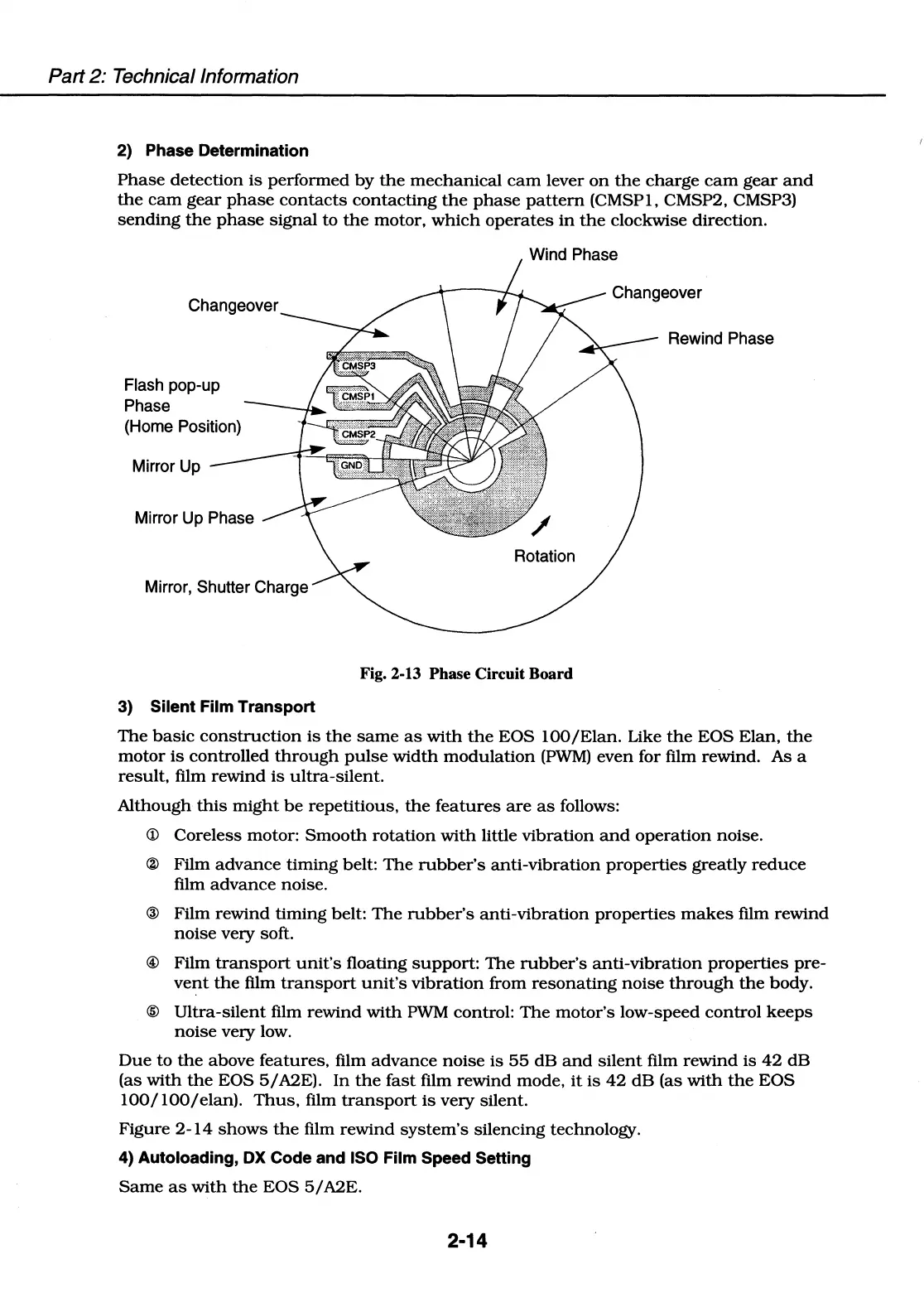
2) Phase Determination
Phase
detection
is
performed
by
the
mechanical
cam
lever
on
the
charge
cam
gear
and
the
cam
gear
phase
contacts
contacting
the
phase
pattern
(CMSPl, CMSP2, CMSP3)
sending
the
phase
signal
to
the
motor,
which
operates
in
the
clockwise direction.
Flash pop-up
Phase
(Home Position)
Mirror Up
Mirror Up Phase
Mirror, Shutter Charge
Wind Phase
Rotation
Fig. 2-13 Phase Circuit Board
3) Silent Film Transport
Rewind Phase
The
basic
construction
is
the
same
as
with
the
EOS
100
/Elan.
Like
the
EOS
Elan,
the
motor
is
controlled
through
pulse
width
modulation
(PWM)
even
for film rewind.
As
a
result,
film rewind
is
ultra-silent.
Although
this
might
be
repetitious,
the
features
are
as
follows:
Q)
Careless
motor:
Smooth
rotation
with
little
vibration
and
operation
noise.
® Film
advance
timing
belt:
The
rubber's
anti-vibration
properties
greatly
reduce
film
advance
noise.
@ Film rewind timing belt:
The
rubber's
anti-vibration
properties
makes
film rewind
noise
very soft.
© Film
transport
unit's
floating
support:
The
rubber's
anti-vibration
properties
pre-
vent
the
film
transport
unit's
vibration
from
resonating
noise
through
the
body.
®
Ultra-silent
film rewind
with
PWM
control:
The
motor's
low-speed
control
keeps
noise
very low.
Due
to
the
above
features,
film
advance
noise
is
55
dB
and
silent
film
rewind
is
42
dB
(as
with
the
EOS 5/A2E).
In
the
fast
film rewind mode,
it
is
42
dB
(as
with
the
EOS
100/100/elan).
Thus,
film
transport
is
very silent.
Figure
2-14
shows
the
film
rewind
system's
silencing technology.
4) Autoloading, DX Code and ISO Film Speed Setting
Same
as
with
the
EOS
5/
A2E.
2-14

Table of Contents

Related product manuals