EasyManua.ls Logo

Canon EOS 50 E - Page 63

Canon EOS 50 E
207 pages
Print Icon
To Next Page IconTo Next Page
To Previous Page IconTo Previous Page
Loading...
Part 2: Technical Information
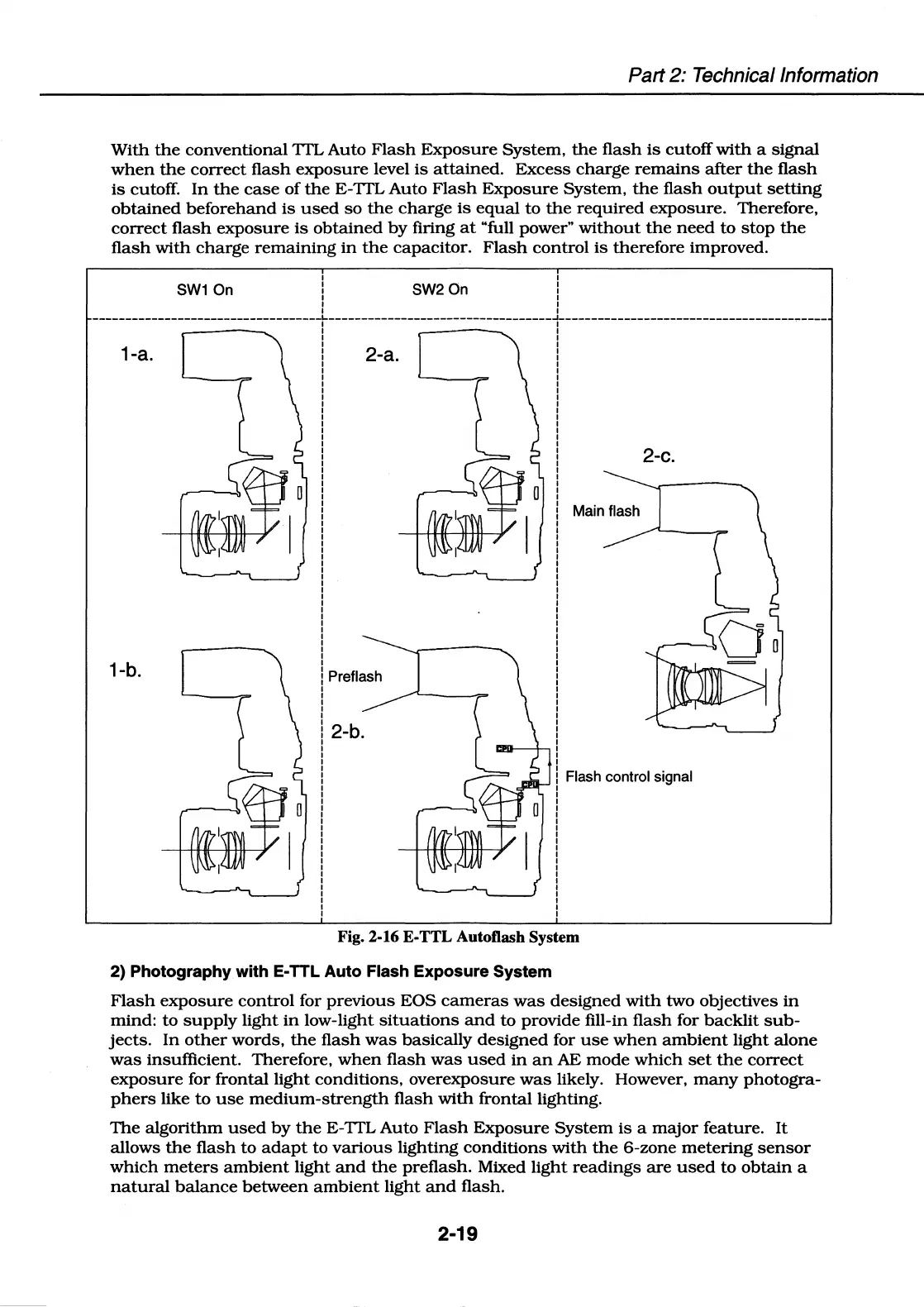
With
the
conventional
TIL
Auto
Flash
Exposure
System,
the
flash
is
cutoff
with
a
signal
when
the
correct
flash
exposure
level
is
attained.
Excess
charge
remains
after
the
flash
is
cutoff.
In
the
case
of
the
E-ITL
Auto
Flash
Exposure
System,
the
flash
output
setting
obtained
beforehand
is
used
so
the
charge
is
equal
to
the
required
exposure.
Therefore,
correct
flash
exposure
is
obtained
by
firing
at
"full power"
without
the
need
to
stop
the
flash
with
charge
remaining
in
the
capacitor.
Flash
control
is
therefore
improved.
I
SW1
On : SW2 On
I
I I
I I
---------------------------------- ~----------------------------------~-----------------------------------------
1-a.
2-c.
Main flash
1-b.
Preflash
2-b.
Flash control signal
Fig. 2-16 E-TTL Autoflash System
2) Photography with E-TTL Auto Flash Exposure System
Flash
exposure
control
for
previous
EOS
cameras
was
designed
with
two
objectives
in
mind:
to
supply
light
in
low-light
situations
and
to
provide
fill-in
flash
for
backlit
sub-
jects.
In
other
words,
the
flash
was
basically
designed
for
use
when
ambient
light
alone
was
insufficient.
Therefore,
when
flash
was
used
in
an
AE
mode
which
set
the
correct
exposure
for
frontal
light
conditions,
overexposure
was
likely. However,
many
photogra-
phers
like
to
use
medium-strength
flash
with
frontal
lighting.
The
algorithm
used
by
the
E-ITL
Auto
Flash
Exposure
System
is
a
major
feature.
It
allows
the
flash
to
adapt
to
various
lighting
conditions
with
the
6-zone
metering
sensor
which
meters
ambient
light
and
the
preflash.
Mixed
light
readings
are
used
to
obtain
a
natural
balance
between
ambient
light
and
flash.
2-19

Table of Contents

Related product manuals