EasyManua.ls Logo

Canon EOS 50 E - Page 67

Canon EOS 50 E
207 pages
Print Icon
To Next Page IconTo Next Page
To Previous Page IconTo Previous Page
Loading...
Part
2:
Technical Information
11)
Calculation
of
main
flash
output
The
E-TI'L
system's
algorithm
calculates
the
main
flash
output
according
ton-
times
the
preflash
output.
The
result
is
sent
to
the
380
EX.
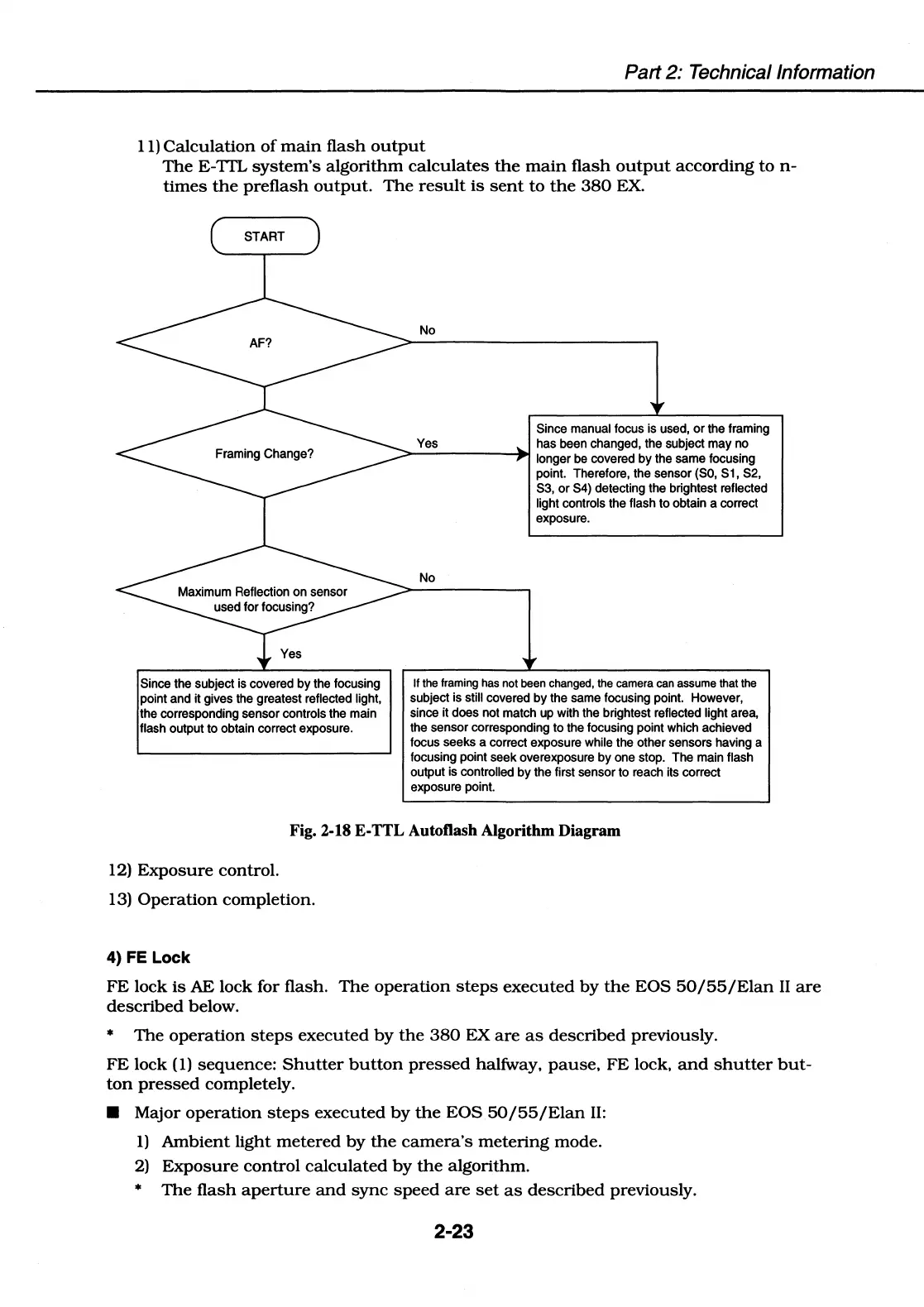
START
Since
the
subject
is
covered
by
the
focusing
point
and
it
gives
the
greatest
reflected
light,
the
corresponding sensor controls
the
main
flash
output
to
obtain
correct
exposure.
No
Yes
Since
manual
focus
is
used,
or
the
framing
has
been
changed,
the
subject
may
no
~--------l.i
longer
be
covered
by
the
same
focusing
No
point.
Therefore,
the
sensor
(SO,
S
1,
S2,
S3,
or
S4)
detecting
the
brightest
reflected
light
controls
the
flash
to
obtain
a
correct
exposure.
If the framing
has
not
been
changed,
the
camera
can
assume that
the
subject
is
still
covered
by
the
same
focusing
point.
However,
since
it
does
not
match
up
with
the
brightest
reflected
light
area,
the
sensor
corresponding
to
the
focusing
point
which
achieved
focus
seeks
a
correct
exposure
while
the
other
sensors
having
a
focusing
point
seek
overexposure
by
one
stop.
The
main
flash
output
is
controlled
by
the
first sensor
to
reach
its
correct
exposure
point.
Fig. 2-18
E-
'ITL Autoftash Algorithm Diagram
12)
Exposure
control.
13)
Operation
completion.
4) FE Lock
FE
lock
is
AE lock for flash.
The
operation
steps
executed
by
the
EOS
50/55/Elan
II
are
described
below.
*
The
operation
steps
executed
by
the
380
EX
are
as
described
previously.
FE
lock (1)
sequence:
Shutter
button
pressed
halfway,
pause,
FE
lock,
and
shutter
but-
ton
pressed
completely.
Major
operation
steps
executed
by
the
EOS
50/55/Elan
II:
1)
Ambient
light
metered
by
the
camera's
metering
mode.
2)
Exposure
control
calculated
by
the
algorithm.
*
The
flash
aperture
and
sync
speed
are
set
as
described
previously.
2-23

Table of Contents

Related product manuals