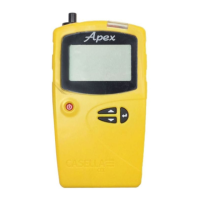
Apex2
33
Why include a motion sensor?
Workers are occasionally resistant to being monitored and feel that wearing the pump
hampers their work. There have been examples of workers taking the equipment off and
leaving it running in a cupboard and picking it up again at the end of a shift to hand it in to
the Occupational Hygienist. The motion sensor tracks the amount of movement and gives an
index to the Occupational Hygienist who can then tell if the sample is a valid one. If the
pump has not been moving all day, it’s quite likely it’s been taken off.
Is wearer acceptance a problem then?
It can be – workers’ may not always see the benefit of being monitored and only see that
wearing a pump will be an unnecessary encumbrance rather than the long term goal of
protecting their health. To try and combat this, the Apex2 has been designed to be less
obtrusive to the wearer. It’s a smaller, slimmer, lighter design, which makes moving around
easier: sitting, standing and climbing. The sturdy clip can be fitted to a variety of belts and
harnesses and the rubber boot guards against knocks and rough treatment.
What is the battery life and charge time and what’s the benefit?
The Apex2 incorporates Li Ion batteries for greater battery life. You can be confident that
you can get to the end of the shift without running out of charge. Battery life does depend
on the application, and factors such as the flow rate and the back pressure must be taken
into account. It is difficult to give a definitive answer as to ‘how long will the charge last’
because it does depend on the individual sample. We can only give guidance.
What is the pulsation value and why is it so important?
When choosing a pump, you should ensure that the pulsation value given is <10% to ensure
confidence in your results. (ISO13137)
Pulsations in air flow can affect the size-cut performance of size-selective sampling heads
such as cyclones. Pulsations can also make the filter vibrate, which means there is a
potential to lose the sample.
With every cycle of the pump, air is drawn in and then exhausted. The resulting air flow will
not be completely smooth and includes an alternating, or pulsating component due to the
pumps rotation. The pulsation performance is expressed as the ratio of the pulsating
component amplitude to the mean (steady) flow rate. A smaller pulsation ratio indicates a
smoother flow of air. The Apex2 incorporates an elastomeric cavity to absorb and minimize
these flow pulsations.
What is the flow control and why is that so important?
During the sample run a number of factors can slow the pump, for example a loaded filter or
reduced battery voltage, resulting in a reduced flow rate. If this happens the air volume
measurement becomes inaccurate, affecting the accuracy of your results. To counter this
potential issue, the Apex2 monitors and maintains flow accuracy so you can have
confidence in your results.
The Apex2 conforms to ISO13137:2013, which states that flow control is ±5% for ambient
temperatures between +5 to 40°C and pressures of 850 to 1,255 mBar. This is the
international standard specifying performance requirements for personal sampling pumps.


 To Next Page