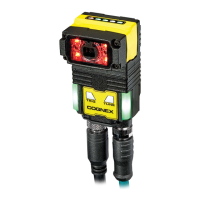
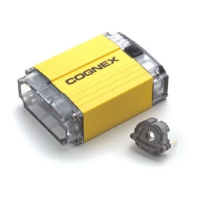
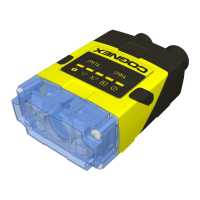
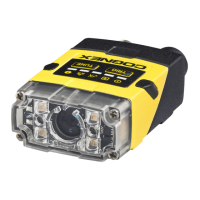
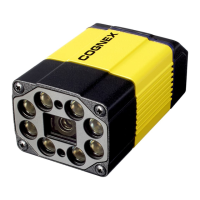
The Cognex DataMan 374 is a versatile industrial barcode reader designed for reliable and efficient code reading in various applications, particularly within collate, OMR folder reading, and insert feeder interfaces. This device is engineered to integrate seamlessly into existing systems, offering robust performance and ease of maintenance.
Function Description
The primary function of the Cognex DataMan 374 is to accurately read barcodes and 2D codes (such as Datamatrix) on documents as they pass through a machine. It supports both top-read and bottom-read configurations, allowing for flexible installation depending on the document flow and code placement. The reader captures images of the codes and processes them to extract the encoded information, which can then be used for various purposes such as tracking, sorting, and quality control.
The device is designed to work in conjunction with a Barcode Interface Board (A0133330) and an IMOS PC, which provides the software interface for setup, alignment, calibration, and real-time monitoring of reading performance. It can be configured for single or multiple reader setups, making it adaptable to different system complexities and throughput requirements.
Usage Features
The Cognex DataMan 374 offers several features that enhance its usability and integration into industrial environments:
- Flexible Mounting Options: The reader can be mounted in either horizontal or vertical orientations, accommodating diverse machine layouts. This flexibility is crucial for optimizing read performance based on the specific application (e.g., collate, OMR folder, or insert feeder). The mounting height and angle are adjustable, allowing for precise positioning relative to the document surface. The reader mount 'lug' ensures secure placement in either top-read or bottom-read configurations.
- Adjustable Reading Angle: The device allows for fine-tuning of the reading angle, with a nominal rotation of 15 degrees left or right. This adjustment is critical for optimizing the reader's view of codes, especially when documents might be slightly skewed or when specific code orientations are present. Thumb lock knobs facilitate easy adjustment of both the angle and side-to-side position.
- Code Reading Direction: The reader's orientation (horizontal or vertical) dictates the optimal code reading direction. Clear guidelines are provided to ensure the correct setup for both top-read and bottom-read mounted readers, ensuring that the device is positioned to capture codes effectively.
- Cable Routing and Looping: The installation guide emphasizes proper cable management, including routing and looping, to ensure that cables are neatly organized and do not interfere with machine operation. This attention to detail helps prevent cable damage and ensures long-term reliability. Cable looping also ensures that the correct cable length is available for readers mounted in their maximum left or right positions, accommodating the full range of motion.
- Connectivity to Barcode Interface Board: The DataMan 374 connects to a dedicated Barcode Interface Board (A0133330), which acts as an intermediary between the reader and the control system. This board handles the necessary electrical interfaces and data communication, simplifying integration. The board supports multiple readers, with specific connection points (J1 for Reader 1, J2 for Reader 2) for organized wiring.
- Connection to IMOS PC: The reader connects to an IMOS PC, which serves as the central control and monitoring station. For single reader setups, a USB/Ethernet Adapter (A0014392) can be plugged directly into an available USB port on the IMOS PC. For multiple readers, a Multi-Reader Kit (A0135969) is available, which includes a USB Switch Hub (A0135968) and Ethernet extension cables (A0015464). This setup allows for up to four readers to be connected and managed simultaneously.
- Software Setup and Configuration: The IMOS software provides a comprehensive interface for configuring the DataMan 374. This includes setting the IP address of the camera port, which is crucial for network communication. The software allows users to navigate through network settings to assign a static IP address, ensuring reliable connectivity.
- Reader Setup Screen: Within the IMOS Menu, the 'Reader Setup' screen allows users to obtain the IP address of each connected reader and verify communication between the insert head and the Cognex Reader. This screen displays important information such as read test percentages, decodes per second, and label content, providing real-time feedback on reader performance.
- Read-Head Orientation Selection: The software allows users to select the correct read-head orientation (Vertical or Horizontal) in the Jobs screen, ensuring that the reader's processing aligns with its physical mounting. This setting is critical for accurate code interpretation.
- Load to Reader Function: The 'Load to Reader' feature in the IMOS run screen facilitates precise positioning of documents under the reader. This function feeds a single document, allowing operators to adjust the reader's position until the label is correctly aligned between the two green lights, indicating optimal read conditions.
- Alignment Test: After positioning the document, an alignment test can be initiated to verify that the code/label content is successfully displayed. This test helps confirm that the reader is correctly aligned and ready for operation. If the alignment test fails or the read rate is less than 100%, the system prompts the user to stop the test and re-evaluate the setup.
- Calibration: The reader can be calibrated through the software to optimize its performance. Calibration ensures that the reader accurately interprets codes under specific operating conditions. The software provides progress information during calibration, and upon completion, an alignment test is recommended to confirm successful setup.
Maintenance Features
The Cognex DataMan 374 is designed with maintenance in mind, offering features that simplify troubleshooting and ensure continuous operation:
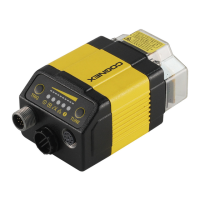
- Indicators and Status Lights: The device includes various indicators such as illumination LED clusters, an indicator light ring, and status lights for power, train status, good/bad read, network, and error. These visual cues provide immediate feedback on the reader's operational status, allowing operators to quickly identify potential issues.
- Laser Safety Label: A laser safety label is present on the device, reminding users of safety precautions when operating the laser, which is important for preventing eye injury.
- Trigger Button: A physical trigger button is available on the device, which can be used for manual triggering during setup or troubleshooting, providing a direct way to initiate a read cycle.
- SD Card Slot: The presence of an SD card slot allows for local storage of configuration files, images, or log data, which can be useful for backup, diagnostics, or transferring settings between devices.
- External Light Control: The reader includes external light control capabilities, allowing for adjustment of illumination to optimize reading performance under varying ambient light conditions or for different code types.
- Power I/O and RS-232: The device offers Power I/O and RS-232 connectivity, providing standard interfaces for power supply and serial communication, which are common in industrial automation and can be used for diagnostics or integration with other control systems.
- Software Diagnostics: The IMOS software includes diagnostic tools and information display, such as version info and barcode reading data, which assist in troubleshooting and monitoring the reader's health and performance. Error messages, like "UNIT 6 - Fault code 291: Label under reader," provide clear instructions for resolving issues, such as completing a static alignment test and clearing the machine.
- Factory Defaults: The software allows users to "Set to factory defaults," providing a quick way to reset the reader's configuration to its original state, which can be useful for resolving complex software-related issues or preparing the reader for a new application.
- Software Updates: The Cognex DataMan 374 is supported by software release R0065 onwards on the DS-1200 G4i, indicating that the device benefits from ongoing software development and updates. This ensures compatibility with new features, performance improvements, and bug fixes, contributing to the reader's longevity and adaptability. Users are advised to contact local support for further information on software releases.
- Recalibration Recommendation: When switching between horizontal and vertical barcode positions, it is recommended to recalibrate the reader. This ensures that the reader's settings are optimized for the new physical orientation, maintaining accurate reading performance.

 Need help?
 General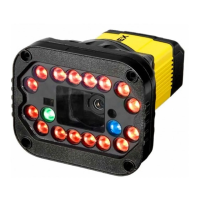


 To Next Page