Basic Information
24
C3M2-OM-EN-02
Warning
The capacity rating of the truck decreases as the load centre of the load
increases and as the load is raised.
Refer to the rated capacity at various heights listed on the load chart.
Failure to heed these guidelines can cause damage to the truck and
property or lead to a tip over causing serious injury or death.
Warning
Make sure that the load is centred and the forks are fully engaged. Failure to
do so can cause the load to fall or the truck to tip over, resulting in serious
injury or death.
2.7 Load Centre & Load Chart
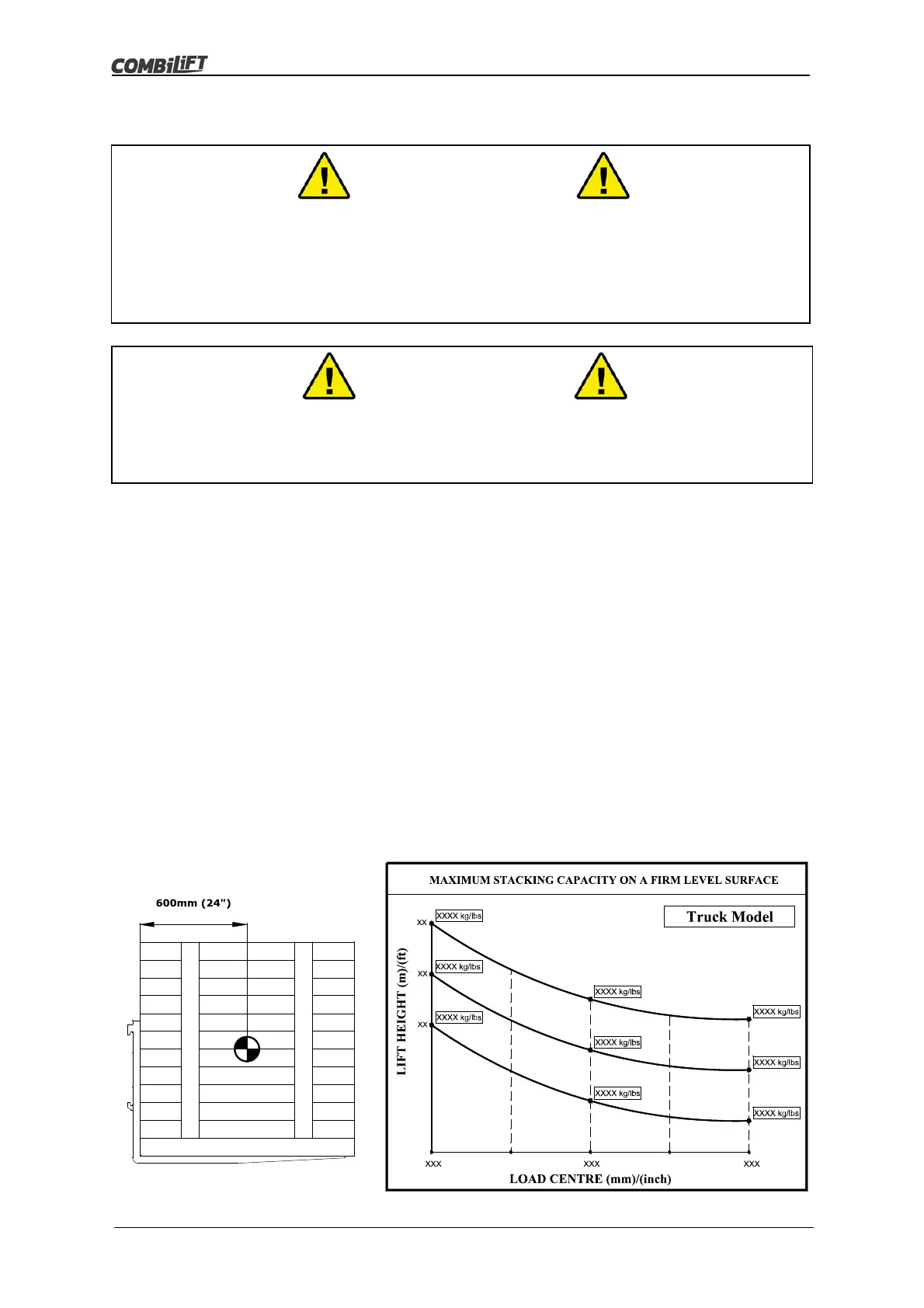
The term “Load Centre” is used to describe the distance from the face of the forks to
the Centre of Gravity of the load when the forks are fully engaged with the load. The
maximum rated capacity of the Combilift is based on a load in the form of a cube
measuring 1200mm (48”) in length, depth and height where the centre of gravity lies
exactly in the centre of the cube i.e. 600mm (24″) from all sides.
If the size or shape of the load changes such that the position of its centre of gravity
moves away from the forks the truck will have less capacity to lift the load.
Raising a load also causes the truck to loose capacity due to mast tilt and deflection.
Therefore as the load centre and/or lift height increases the weight that can be safely
lifted reduces.
The trucks capacities at various heights and load centres are displayed on a load chart
located inside the operating enclosure. A sample load chart is shown below.



 To Next Page