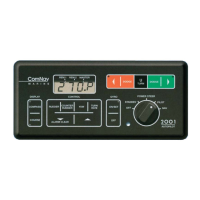
ComNav Marine 1420 Autopilot System
Installing the Pump
Installation of the pump consists of:
• Finding a mounting location for the pump
• Partially draining the steering system
• Mounting and connecting the pump to the existing steering lines
• Filling and bleeding the steering system
A suitable mounting location for the pump MUST:
• Be dry
• Be lower than at least one of the helm pumps in the steering system
• Provide a solid mounting base
• Be at least 4 feet (3.1 m) from the vessel's compass
A mounting location for the pump SHOULD:
• Provide easy access to the pump
• Provide an easy connection point to the steering system
• Minimize the length of the pump hoses
• Minimize the length of the wires to the motor
A typical mounting location would be in the engine compartment or the steering console.
The pump can be mounted in any orientation except with Port C facing downward
. If Port
C is facing downward then air will not be able to rise out of the pump and the pump will
not have a supply of oil.
There are two ways to connect the pump to the steering system. The first is to leave the
system completely filled and be careful not to spill hydraulic fluid. The second is to drain
the system of fluid completely before cutting or opening any lines.
If you follow the first method, remember that when you disconnect or cut the steering
lines, there will be a constant slow discharge of oil due to gravity draining the system.
Have a container ready to catch all excess oil. Do not reuse any oil reclaimed from your
system.
If you wish to follow the second method and drain the system, use the following simple
procedure.
1. Have a large container, about 2 gallons, ready.
2. Disconnect the delivery lines at a low point, usually where the lines connect to the
steering cylinder.
3. Turn the wheel of the highest helm pump in both directions until no more fluid
comes out of the lines.
4. Repeat the previous step on each lower helm pump in turn.
Document PN 29010012 V1.3
27


 To Next Page