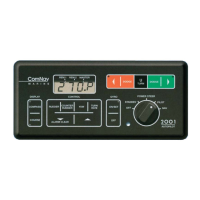
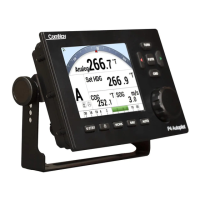
ComNav Marine 1420 Autopilot System
Document PN 29010012 V1.3
46
Determining Rudder Response
Settings
⇒ If your vessel is swinging back and
forth across the Course line, like this:
At this point, you will have finished
adjusting your compass. Move your boat
to an open area of water away from
docks and other boats.
Your vessel will normally make
several turns, while you are setting the
Rudder Responses. Make sure that
you and your passengers are braced
for unexpected movement.
These adjustments are much easier to do
if the water is calm and there is little wind.
– … the Rudder Response Sensitivity is
set too high. The swinging occurs
because the Autopilot is overcorrecting
for course errors.
Setting the Slow Speed Rudder
Response
It is best to set the slow speed Rudder
Response first.
⇒ You must decrease the Slow Speed
Rudder Response Sensitivity.
Adjust your throttle so that your boat is
moving at the “slow” speed which you
normally use. For example, if you often
go fishing, this would be your trolling
speed.
But that’s easy to do – and the 14
Sensitivity levels mean you can find one
that suits your vessel.
To decrease the Sensitivity:
Bring your boat onto a Course.
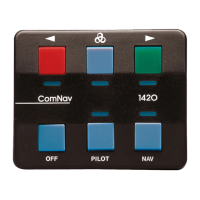
Press and hold the Speed Key
. Press the
Red Key
once: Sensitivity decreases by
one step. Wait for the vessel to settle on
a steady Course. This could take up to 5
minutes, so please be patient.
Turn the Autopilot ON.
If the light beneath the Speed Key
is on,
the Autopilot is using the Fast Speed
Response, so press the Speed Key
twice quickly to select Slow Speed
Response (the Speed Key
light should
be off).
Continue this procedure until the boat is
steering satisfactorily.
If the pilot light goes off, followed by
blinking port and starboard lights, you
have reached the lowest level of the Slow
Response Sensitivity. From here, you
can only increase Sensitivity (using the
Green Key
)
2
.
2
You cannot make adjustments during the “limit
reached” blinking-lights interval (4 seconds).


 To Next Page