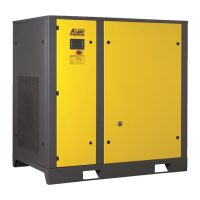
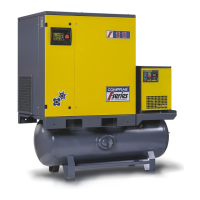
Main components
1 Electric motor 11 Min. Pressure valve
2 Belt drive 12 Non-return valve
3 Air end 13 Heat-exchanger, Air section
4 Air lter 14 Heat-exchanger, Oil section
5 Intake valve 15 Thermostatic valve
6 Air-Oil separation tank 16 Oil lter
7 Safety valve 17 Drain valve
8 Air-Oil separator 18 Oil lling plug
9 Throttle valve 19 Oil level sight glass
10 Non-return valve 20 Air outlet valve
2.4 Functional description (see Fig. 2.3)
Air ow:
Air drawn through Air
lter
(4) and open Intake valve (5) into compressor Air-end (3) is compressed.
Compressed air and oil ow into Air-Oil separation tank (6). The air is discharged via Min.
Pressure valve (11) through Heat-exchanger (13) towards the Air Outlet Valve (20).
Oil ow:
Air pressure forces oil from the air-oil separation tank (6) through the heat-exchanger (14)
and the oil lter (16) to the compressor air-end (3) and the lubrication points. In the air-oil
separation tank (6), most of the oil is removed centrifugally; the rest is removed by the
air-oil separator (8).
The oil system is tted with a thermostatic valve (15). When the oil temperature is below
the set-point of the thermostatic valve, the thermostatic valve shuts off the oil
su
pply
from
oil heat-exchanger (14). The thermostatic valve starts opening the supply from heat-
exchanger (14) when the oil temperature exceeds the valve’s setting. The setting of the
thermostatic valve depends on the model. See table Technical Data.
Cooling system:
The cooling system comprises a combined air section (13) and an oil section (14) heat-
exchanger. A cooling fan, mounted directly on the motor shaft, generates the cooling air in
order to cool the heat-exchanger.
2.5
Regulating system
The system is controlled by an electronic controller pro-Log (4) which keeps the net
pressure within programmable pressure limits by automatically loading and unloading the
compressor in relation to air consumption.



 To Next Page