Need help?
Do you have a question about the Copley Controls Xenus XSL and is the answer not in the manual?
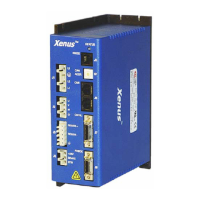
Describes the operation and installation of the Xenus amplifier.
Lists other Copley Controls documents relevant to CANopen features.
Invites user comments on the manual and provides contact info.
States document reproduction permissions and lists registered trademarks.
Reserves the right to modify products and information without notice.
Warns about hazardous voltages and advises caution during installation.
Warns about high-voltage circuits connected to mains power.
Warns about unexpected motion after correcting non-latched faults.
Warns that CME 2 or serial commands can affect ongoing CAN operations.
Explains that custom outputs don't latch faults, risking unexpected motion.
Advises operating amplifiers strictly within the manual's specifications.
Overview of Xenus amplifier capabilities, versions, and models.
Describes CME 2 software for commissioning, multi-drop features.
Introduces Copley Motion Libraries (CML) and Objects (CMO) for CANopen.
Explains the power distribution within the Xenus amplifier.
Discusses synchronizing PWM switching frequency among multiple amplifiers.
Details the three commutation modes for driving motors (sinusoidal, trapezoidal, DC).
Covers encoder and resolver support and secondary encoder interface options.
Explains different operating modes (current, velocity, position) and control loops.
Describes CANopen network, profiles for motion, and supported modes.
Explains how to use digital inputs for limit switches and amplifier response.
Details how digital outputs control the brake and brake/stop sequences.
Explains the amplifier and CAN interface status indicator LEDs.
Covers amplifier protection mechanisms, including faults and clearing procedures.
Discusses error handling methods like following error and tracking windows.
Describes communication interfaces (RS-232, CAN) and CME 2 interaction.
Details digital inputs, input filters, debounce time, and programmable functions.
Explains digital outputs, standard and custom output functions.
Explains regeneration, regen resistors, and circuit components.
Lists CE and UL compliance standards for the amplifier.
Specifies mains voltage, frequency, current, and logic supply requirements.
Details peak current, continuous current, efficiency, and output type.
Lists control loop types, sampling rates, bandwidth, and filters.
Provides specifications for continuous power, peak power, and energy absorption.
Details digital position, and digital current & velocity command inputs.
Specifies channels, measurement range, impedance, and bandwidth.
Lists channels, types, input voltage ranges, and debounce settings.
Details channels, type, maximum voltage, sink current, and function.
Specifies type, maximum sink current, and function for brake control.
Specifies voltage output, maximum current, and protection for encoders.
Details channels, type, signals, and maximum frequency for encoder inputs.
Specifies channels, type, signals, nominal voltage, and bandwidth.
Lists channels, type, input voltage ranges, and RC filter time constant.
Details resolution, reference frequency, voltage, and current for resolver interface.
Specifies channels, type, signals, and maximum frequency for encoder outputs.
Details channels, type, signals, baud rate, data format, and protocol.
Specifies channels, connectors, signals, format, protocol, and supported modes.
Describes the amplifier and CAN interface status indicator LEDs.
Lists fault conditions and their threshold levels.
Shows power dissipation charts for different models and mains voltages.
Refers to thermal considerations for heatsink and cooling configurations.
Details size, weight, ambient temperature, humidity, and environment ratings.
Provides mechanical drawings with dimensions for the amplifier.
Covers electrical codes, warnings, and grounding considerations.
Details the mating connector, pin assignments, and wiring diagrams for AC mains.
Describes the motor connector and provides wiring diagrams for brushless and brush motors.
Explains the regen resistor connector, pin assignments, and wiring diagram.
Details the logic supply/brake connector and its wiring diagram.
Describes the RS-232 connector, pin assignments, and wiring diagram for PC communication.
Details the CAN bus connector, pin assignments, and wiring diagrams.
Describes the motor feedback connector and provides wiring diagrams for various feedback types.
Presents critical safety warnings for CME 2 setup and amplifier operation.
Guides through CME 2 software installation and serial port configuration.
Lists hardware, equipment, and wiring prerequisites before starting setup.
Covers initial amplifier setup including motor family, type, and commutation.
Details methods for performing motor setup using data files or manual entry.
Guides on configuring rotary and linear motor feedback options.
Explains how to configure brake/stop parameters for safety and holding.
Covers configuration of digital inputs, outputs, custom outputs, and fault latching.
Details how to configure analog, PWM, digital position, and CAN command inputs.
Guides through the auto phase procedure for motor wiring and Hall setup.
Covers current loop settings and manual tuning procedures.
Explains velocity loop settings and manual tuning procedures.
Details position loop settings, manual tuning, and S-curve profile testing.
Outlines final steps to save configuration and perform testing.
Provides an overview of CME 2 software features and the main screen layout.
Explains how to manage amplifier and motor data using memory and disk storage.
Guides on acquiring and downloading firmware updates to the amplifier.
Details the Control Panel's functions for monitoring and controlling the amplifier.
Explains how to use the Scope Tool for tuning, monitoring, and diagnostics.
Describes how to view and manage error and communications logs.
Covers using virtual amplifiers for training and offline file creation.
Provides instructions for manual motor phasing and troubleshooting.
Guides through the auto-tuning process for the current loop.
Explains how to set and test homing parameters using the Home function.
Describes formulas to determine regen resistor requirements based on application.
Guides on configuring amplifier settings for a custom regen resistor.
Explains the I2T current limit algorithm, formulas, and operation.
Details filter overview, types (Low-Pass, Bi-Quad), and instructions.
Shows allowable ambient temperatures for Xenus amplifiers based on cooling options.
Provides instructions for mounting heatsinks using phase change material.
Introduces the XSL-FA-01 edge filter for minimizing output noise.
Lists electrical specifications for the XSL-FA-01 edge filter.
Discusses cooling requirements and fan mounting guidelines for the filter.
Shows mounting dimensions for the XSL-FA-01 edge filter.
Describes wiring of the XSL-FA-01 edge filter, including codes and connector locations.
Lists model numbers and connector kit part numbers for ordering the edge filter.
Explains using RS-232 for single-axis control and multi-drop gateway setups.
Details ServoTube basic setup, motor/feedback configuration, and initial values.
Guides through ServoTube auto and manual phase procedures for motor setup.
Instructs on completing the ServoTube setup by returning to general procedures.
Lists part numbers for various Xenus amplifier models and configurations.
Lists part numbers for software, connector kits, and other accessories.
Provides an example of how to order amplifier and related accessories.
Details wire color codes for control and feedback cables.
Lists specifications and dimensions for Regen Resistor models.
 General
| Model | Xenus XSL |
|---|---|
| Digital Outputs | 4 |
| Analog Inputs | 2 |
| Communication Protocols | CANopen |
| Continuous Current | 10 A |
| Peak Current | 20 A |
| Feedback | Incremental Encoder, Hall Sensors |
| Operating Temperature | 0°C to +55°C |
| Protection | Overvoltage, Undervoltage, Overcurrent, Overtemperature, Short Circuit |

 To Next Page