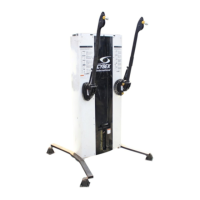
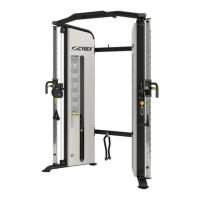
Cybex FT-360S Functional Trainer Owner’s Manual
General Exercise
Guidelines
Page 3-3
Anthropometrics - measurements and relationships of length and girth of body parts.
Antagonist - the muscle in opposition to the agonist.
Anatomical Position - standing erect, with feet and palms facing forward.
Anatomical Pulley - a bone or skeletal prominence that alters the direction of the pull of a muscle to
increase the muscle’s mechanical advantage.
Anatomy - geography, naming by orientation and/or apparent capability (non-functional).
Anchor Points - the points at which a load enters and exits the body and/or limb.
Anterior - anatomical term meaning towards the front. Same as ventral.
Assistant Mover - a muscle that is less effective at performing a specifi ed motion, but does have
a small degree of mechanical ability to help the prime mover. There are many borderline cases.
Atrophy - reduction in size of cells and tissues.
Axis of Rotation - imaginary line or point which an object rotates.
Bilateral - refers to both sides.
Biolocomotion - a perspective/description of the human body and its mechanics based upon
locomotion. All animals with legs (regardless of numbers) move with the same mechanics. Gravity is
the common denominator.
Biomechanics - analysis of the load placed on a joint by both the muscle and resistance. Anatomy,
Kinesiology, and Physics = Engineering.
Body composition - the component parts of the body - mainly fat and fat-free weight.
Calorie - a unit of work or energy equal to the amount of heat required to raise the temperature of
1 g of water to 1 degree C.
Cam - a mechanical device used to vary leverage.
Carbohydrate - a chemical compound consisting of carbon, hydrogen and oxygen atoms in specifi ed
arrangements. Carbohydrates are major components of food such as bread, potatoes and rice.
Cardiovascular - pertaining to the heart and blood vessels.
Cartilage - there are several types. Hyaline cartilage is a relatively thin covering on the ends of many
bones. It forms a smooth, resilient, low friction surface for the movement of one bone on another.
Wedges of cartilage (fi brocartilage) called menisci, disks and labrums are to increase stability,
provide shock absorption, and to facilitate motion in some joints.


 To Next Page