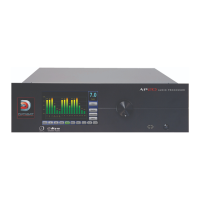
AP25 Installation and Operating Guide Version 1.00
Appendix H. Serial Command AP! H-2 Document #: 9301H79500 Ver. 1.00
Application Programming
Custom programs can be written to communicate with the AP25 using standard TCP/IP communications. An
example C language interface is included at the end of this document for reference.
Password Protection
The AP25 may be protected from unauthorized access by setting a password under the System > Access
Control screen. There are two levels of password protection in the AP25, labeled NetCmd Password and
Setup Password.
NetCmd Password
The NetCmd Password is used to prevent unauthorized access to the AP25 through a network connection. The
NetCmd Password does not prevent access through the serial command.
Setup Password
The Setup Password prevents unauthorized access to any AP25 setup commands through the AP25 local front
panel or remotely through serial or Ethernet connections. This does not affect the operator level commands
that are used in this document.
Authentication Command
The AUTH command must be sent to the AP25 before sending a password protected command. If this is not
done, then the command results in no action and the AP25 returns the string “SECERR”. Sending the correct
password enables all network commands for the password level for as long as the network connection is
maintained.
Not all network commands require a password. Inquiry commands such as SYSTEM and IDENTIFY will
operate without a password.
Command Format
The general command format for all configuration commands is listed below:
@COMMAND [ARG1] [ARG2] <CR>
Each COMMAND and its arguments are defined in this document. Whether or not [ARG1] and/or [ARG2]
are used depends on the command. Square brackets [] around the arguments in this document indicate that the
argument is optional.
The command is terminated by a <CR>. The response returns ASCII text and is also terminated by <CR>
character at the end. The <CR> represents an ASCII character with the value 0x0D. How to enter this
character in the command is entirely dependant on the remote program or interface used. On a terminal
interface, it is added by pressing ENTER on the keyboard. In some GUI interfaces it is represented by “\r”,
and for XML it may be 
.
Important: If you are having problems with executing a simple command to the AP25, check that the
command string starts with ‘@’ and properly sends the carriage return at the end.
Some commands are characterized as “Read” and are used only to read status or information from the AP25.
Commands that are “Read/Write” can be used to set the specific configuration item, or just read it.
For “Read/Write” commands the last argument is the value to write to the configuration. Omit the final
argument in order to read the configuration item without changing it.
General Commands


 To Next Page