DS5 Isolated Bipolar Constant Current Stimulator DS5 Operator's Manual 5.0
ANNEX 4:- Guidance on System Integration
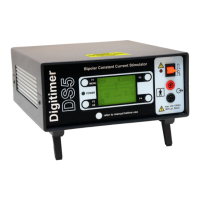
The DS5 Stimulator relies for its action upon the simultaneous use of other pieces of equipment as it does
not, itself, contain a signal generator. So, for example, when used for “threshold tracking” studies it would
be used alongside an EMG recorder and a personal computer. The computer would be used to analyse the
signal from the EMG recorder and produce the stimulation waveform from a fitted digital-to-analogue
interface card. In this example the DS5 and the EMG recorder are equipment designed as Medical Electrical
Equipment, while the computer is not specifically designed as medical equipment.
Using a combination of Medical Electrical Equipment (M.E.E.) and “non-M.E.E.” can introduce hazards;
careful consideration is required of equipment choice and how it is connected together.
The use of a combination of equipment creates a “system”. The international collateral standard IEC /(EN)
60601-1-1 “Safety Requirements for Medical Electrical Systems” contains the requirements for continued
safety and guidance on integration. This is also now covered in IEC60601-1:2005 at Clause 16. Users
should familarise themselves with these requirements.
Connection of non-medical equipment into a medical system can introduce leakage (or touch) currents in
excess of that allowed for medical equipment into the patient environment. For Users of the DS5 involved in
threshold tracking studies there are two methods by which this hazard can be eliminated.
I.
Power the computer via a separation or isolation transformer. This removes the leakage currents from
the computer circuits.
II.
Keep all equipment outside the Patient Environment. The Patient Environment is generally considered to
be the patients bed or couch and the space surrounding it, to a distance of 1.5 metres. For the DS5 this
is easily achieved using the 4m Output Extension Lead, part number D185-HB4. However separate
measures would be required to move the EMG recorder outside the Patient Environment.
With either solution some other factors should also be remembered.
Never touch the patient whilst simultaneously touching the “non-medical” parts of the system. With
the DS5 this would extend to the BNC connectors on the rear panel.
Using portable multiple socket outlets can introduce new risks. They are easily damaged and a fault
in the multiple socket outlet can mean that the leakage currents of all the connected equipment
appear in the patient connected equipment.
If a portable multiple socket outlet must be used keep it off the floor (where it is most easily
damaged). It is better to use permanent wall mounted socket outlets.
Never use multiple socket outlets plugged into one another (a “daisy chain”) or from an extension
lead.
Should you be in any doubt over the correct steps to take when connecting the DS5 into a system, obtain
advice from your orginisations Bio-engineering / Medical Physics / E.B.M.E. department. Advice may also be
obtained from Digitimer Ltd.
Digitimer Ltd. 51 of 52 Copyright © 2009


 To Next Page