Safety Section
-13-
Operating the Lift Truck
Always keep the lift truck under control.
Obey all traffic rules and warning signs.
Never leave the lift truck with the engine operating, or with
the parking brake disengaged.
Operate the engine only in a well ventilated area.
Lower a mast, with or without load, before turning or
traveling. Tip over could result. Watch out for overhead
obstructions.
Always observe floor load limits and overhead clearance.
Start, turn, and brake smoothly, slow down for turns,
grades, slippery or uneven surfaces.
Use special care when operation on grades. Do not angle
across or turn on grades. Do not use lift truck on slippery
grades. Travel with forks downgrade when unloaded.
Travel with load upgrade.
Do not overload, or handle offset, unstable, or loosely
stacked loads. Refer to load capacity plate on the lift truck.
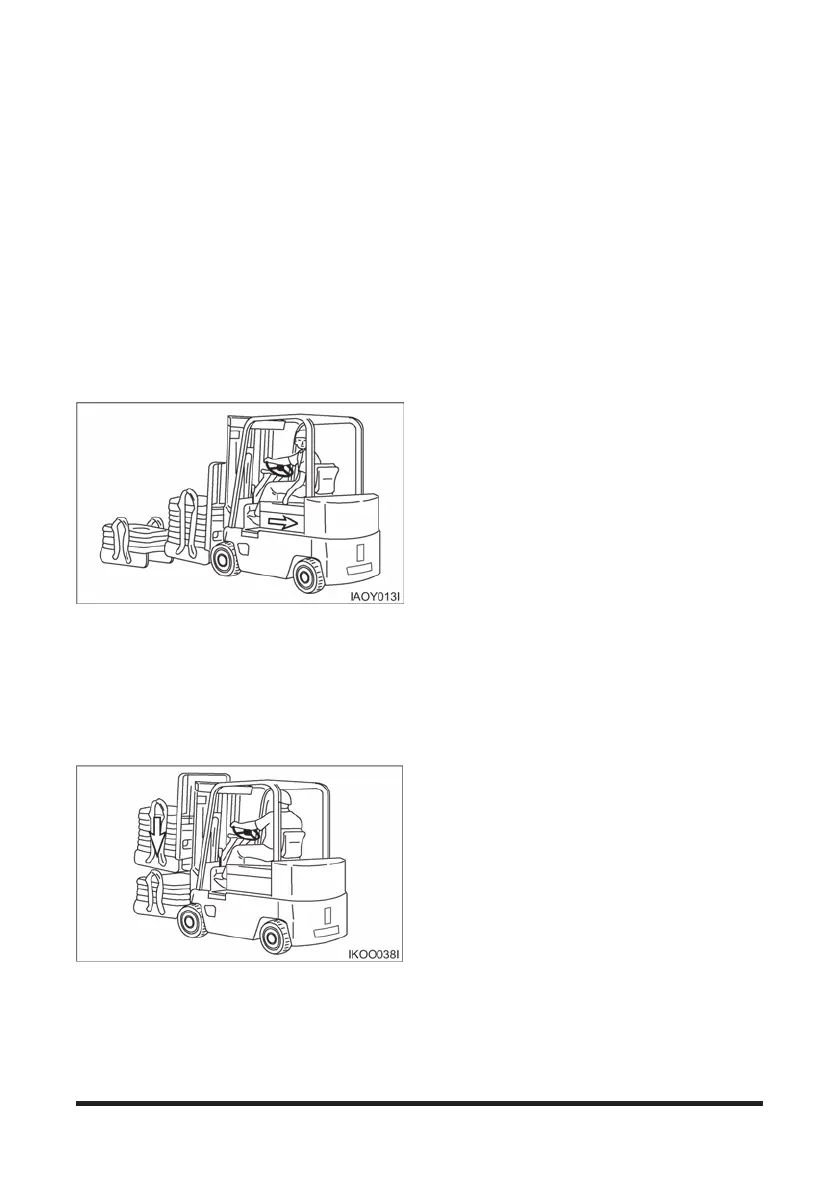
Use extreme caution when handing suspended, long,
high or wide load.
Tilt elevated load forward only when directly over
unloading area and with load as low as possible.
Do not stunt ride or indulge in horseplay.
Always look and keep a clear view of the path of travel.
Travel in reverse if load or attachment obstructs visibility.
Use extreme caution if visibility is obstructed.
Stay in designated travel path, clear of dock edges,
ditches, other drop-offs and surfaces which cannot safely
support the lift truck.
Slow down and use extra care through doorways,
intersections and other location where visibility is reduced.
Slow down for and avoid pedestrians, other vehicles,
obstruction, pot holes and other hazards or objects in the
path of travel.
Always use overhead guards except where operation
conditions do not permit. Do not operate lift truck in high
stacking areas without overhead guards.
When stacking, watch for falling objects. Use load
backrest extension and overhead guard.
Refer to the topic “Operation Techniques” in the
“Operation Section” of this manual.
Loading or Unloading Trucks/Trailers
Do not operate lift trucks on trucks or trailers which are
not designed or intended for that purpose. Be certain
truck or trailer brakes are applied and wheel chocks in
place (or be certain unit is locked to the loading dock)
before entering onto trucks or trailers.
If trailer is not coupled to tractor, make sure the trailer
landing gear is properly secured in place. On some
trailers, extra supports may be needed to prevent
upending or corner dipping.
Be certain dock plates are in good condition and properly
placed and secured. Do not exceed the rated capacity of
dock boards or bridge plates.



 To Next Page