Maintenance Section
-165-
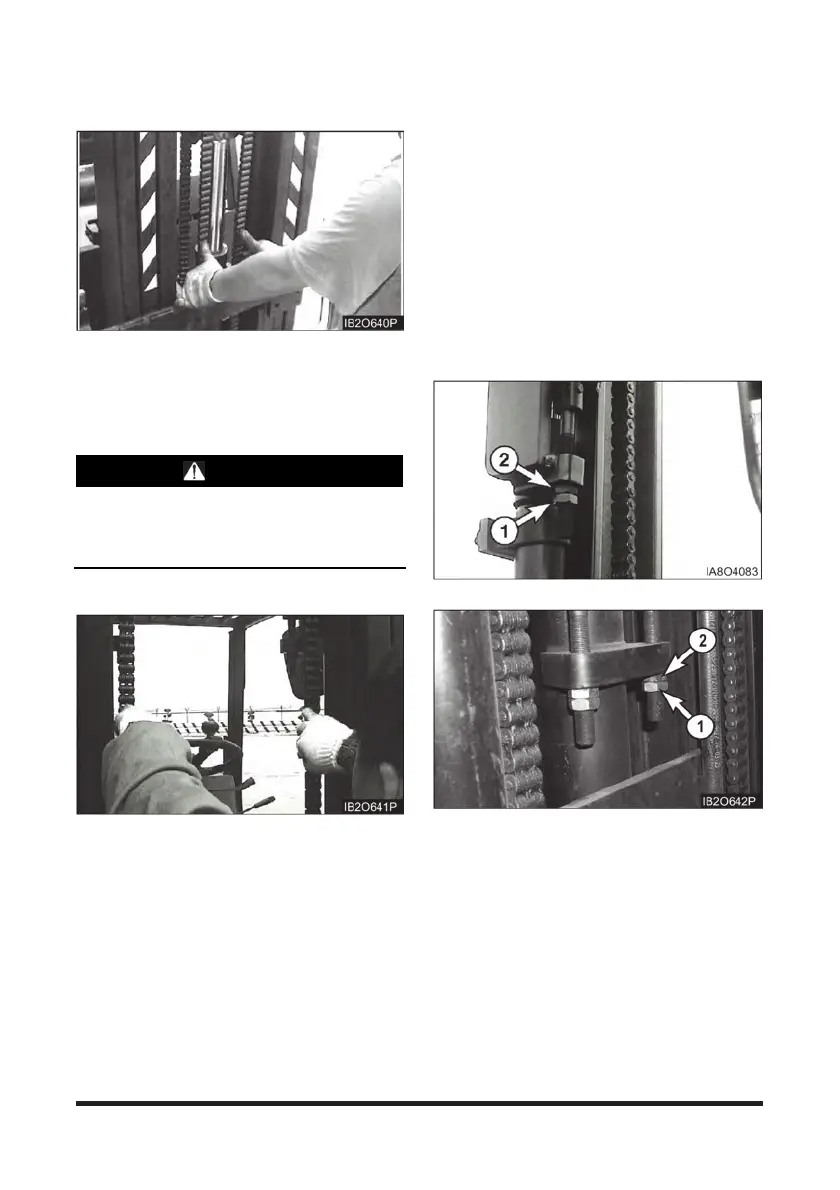
Check for Equal Tension
Typical example
Lift the carriage and the mast high enough for getting
tension on lift chains. Check the chains, and make sure
the tension is the same. Lift chains are required to check
for equal tension about every 1,000 service hours or 6
months.
WARNING
Personal injury can be caused by sudden movement
of the mast and carriage.
Keep hands and feet clear of any parts that can move.
Lift Chain Adjustment
Typical example for carriage equal tension
If the tension is not the same on both chains, take the
procedure as follows.
NOTE: If carriage height is not correct, make
adjustments by following procedures.
Carriage Chain Adjustment
Make sure that carriage height is correct. If correct, adjust
the chain for equal tension. If not, adjust the chain for
correct carriage height by adjusting anchor nuts (1),(2).
NOTE: See the previous section, “Carriage Roller
Extrusion” in “When Required” for proper height
of carriage.
1. Fully lower the carriage and tilt mast forward or lift the
carriage and put blocks under the carriage to release
the tension from the lift chains.
2. Loosen nut (1) and adjust nut(2) to get proper
distance from bottom of inner upright to the bottom
of carriage bearing.
Typical example for carriage chain of STD mast
Typical example for carriage chain of FF,FFT mast
3. Make adjustment anchor nut (1),(2) for equal chain
tension.
4. Set the mast vertical and raise the carriage and
check equal chain tension. If not equal, repeat the
same procedure as step 1 through step 3.
5. Put LOCTITE No. 242 Tread lock on the threads of
the anchor nuts (1),(2) after the adjustment is
completed.



 To Next Page