G643(E) Service Manual Chapter 5. Engine Management System (EMS) 164
The SECM makes any necessary corrections to the
air-fuel ratio by controlling the inlet fuel pressure to
the air-fuel mixer Reducing the fuel pressure leans
the air/fuel mixture and increasing the fuel pressure
enriches the air-fuel mixture. Control is achieved by
modulating the fuel trim valves.
Speed Management
Drive-by-wire refers to the fact that the MI-07 control
system has no throttle cable from the foot pedal to
the throttle body. Instead, the SECM is electronically
connected both to the foot pedal assembly and the
throttle body.
The SECM monitors the foot pedal position and
controls the throttle plate by driving a DC motor
connected to the throttle. The DC motor actuates the
throttle plate to correspond to the foot pedal position
when the operator depresses the pedal. The SECM
will override the pedal command above a maximum
engine speed and below a minimum idle speed.
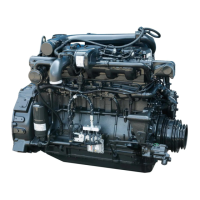
Figure 19. Foot Pedal
The use of electronic throttle control (ETC) ensures
that the engine receives only the correct amount of
throttle opening for any given situation, greatly
improving idle quality and drivability.
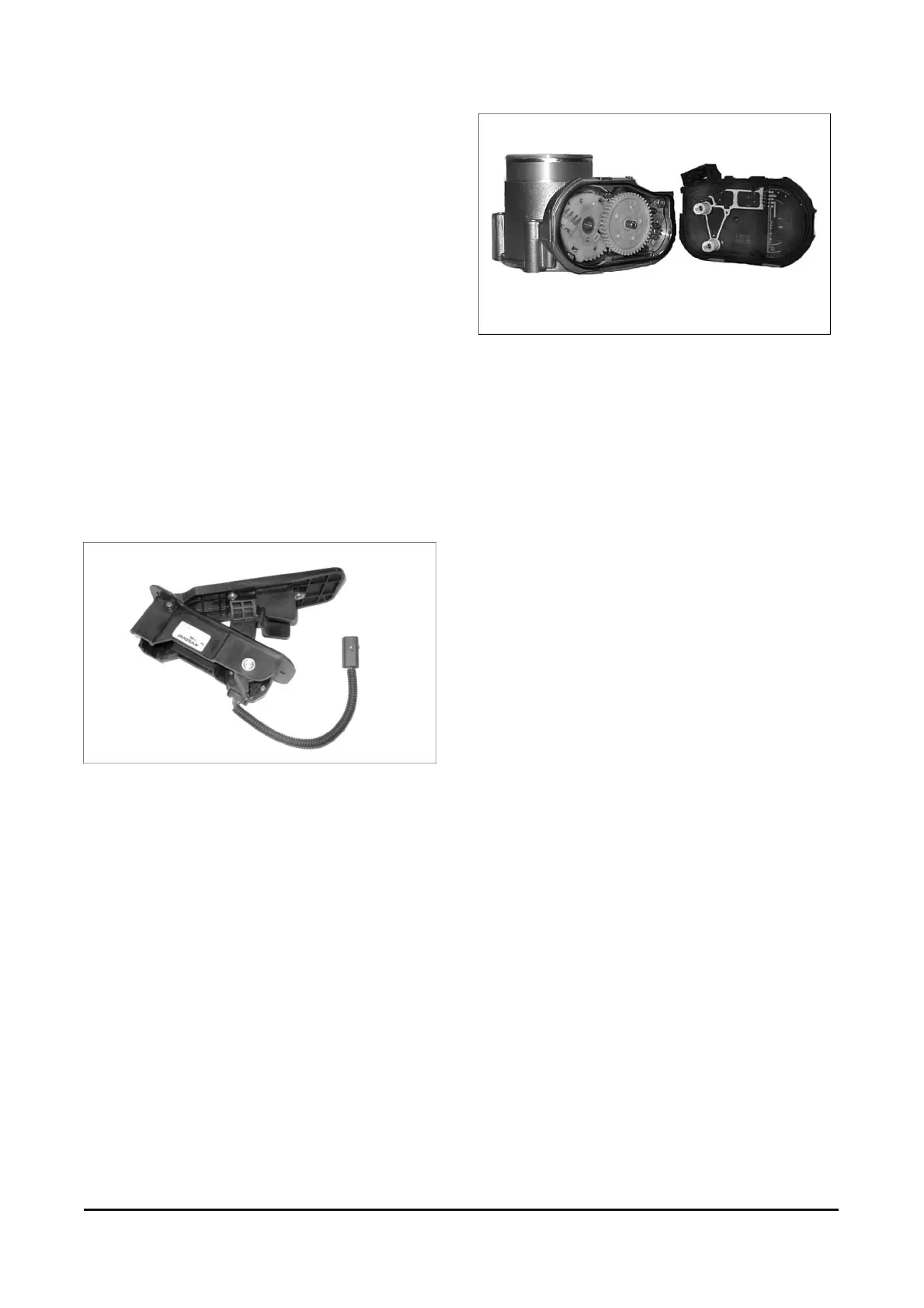
Two throttle position sensors (TPS1 and TPS2),
which are integral to the drive-by-wire (DBW) throttle
assembly, provide feedback for position control by
monitoring the exact position of the throttle valve.
See Figure 20.
SECM self-calibration and “cross checking”
compares both signals and then checks for errors.
Figure 20. Throttle Position Sensor (TPS) on DV-E5
Throttle
NOTE : The DV-E5 throttle is not a serviceable
assembly. If a TPS sensor fails, the assembly
should be replaced.
The MI-07 system also performs minimum (min) and
maximum (max) speed governing through the
SECM and DBW throttle. For min governing, or idle
speed control, the idle speed is fixed by the SECM.
Unlike a mechanical system, the idle speed is not
adjustable by the end user. The idle speed is
adjusted by the SECM based on engine coolant
temperature. At these low engine speeds, the SECM
uses spark and throttle to maintain a constant speed
regardless of load.
The MI-07 system eliminates the need for air
velocity governors. This substantially increases the
peak torque and power available for a given system
as shown in Figure 21. When the engine speed
reaches the max governing point the speed is
controlled by closing the DBW throttle. Using the
DBW throttle as the primary engine speed control
allows for a smooth transition into and out of the
governor. If excessive over speed is detected, the
engine is shut down.



 To Next Page