16
Step 9: If the receiver (DRL3-IP) is on a different network segment than the T-Link module, the
gateway address associated with the T-Link module must be programmed in section [008].
This is an optional step; determine if this is required with the network administrator.
Step 10: Program the T-Link’s account number in section [003].
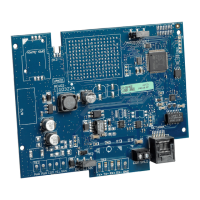
Step 11: After all T-Link TL250 module programming is complete, you must restart the module so
the programming changes will take effect. To restart the T-Link module enter the digits
[55] in T-Link programming section [999] and wait 15 seconds for the module to reboot.
Once complete, press the [#] key to exit T-Link TL250 programming.
Maxsys V3.5 Only:
If the panel sends events to Receiver 0, the T-Link will perform backups automatically to
IPs from Receiver 1 and Receiver 2. If the panels sends events to specific receivers then
the panel will be responsible for all backup/alternate dial functions.
NOTE: The IP Receiver addresses are programmed in the T-Link TL250.
9.2 Basic Programming (PC5020 Control Panel)
NOTE: PC5020 software version 3.2 or higher required (Rev03 hardware).
Programming Steps:
Step 1: Program the hex digits [DCAA] in the telephone number that will be used for T-Link
TL250 communications (section [301] to [303], ‘Telephone Phone Number Program-
ming’).
NOTE: The leading digit [D] in the telephone number for dial tone detection is already pro-
grammed.
Step 2: Program the communication format as SIA FSK format in section [350] and Auto SIA,
option 3 in section [381] has to be OFF.
Step 3: Program the call direction options in section [351] to [376] for the phone number being
used to communicate using T-Link TL250.
Step 4: Section [382] Option 5 ‘PC-Link Active’ option must be ON to enable T-Link TL250 com-
munication.
Step 5: Enter section [851] for T-Link TL250 module programming options.
NOTE: Option [5] in Section [382] must be enabled to access this section.
Step 6: Program the static IP address for the T-Link TL250 module in section [001]. Program
000.000.000.000 for DHCP.
Step 7: Program the subnet mask for the T-Link TL250 module in section [002]. This option will
be ignored if the unit is set for DHCP.
Step 8: Program the static IP address of the receiver (DRL3-IP line card) in section [007].
Step 9: If the receiver (DRL3-IP) is on a different network segment than the T-Link TL250 mod-
ule, the gateway address associated with the T-Link TL250 module
must be programmed in
section [008]. This is an optional step; verify with the network administrator if this is
required.
9.3 T-Link DVACS Programming
Obtain the following information from the station monitoring the DVACS alarm panel:
1. The SG-DVL2A Receiver number and line number that the DVACS panel is connected to.
2. The DVACS panel ID (Account Number).
3. The programmed value of the SG-DVL2A extended format (option 07) for step 2 below.
CAAA = Receiver 0 CCCC = Receiver 2
CBBB = Receiver 1 CDDD = Receiver 3


 To Next Page
 Loading...