17
Step 1: Program the Account Number of the DVACS control panel in the DVACS account option
of the T-Link (option 067). The T-link will use this number to supervise the control panel
and poll for DVACS signals from the panel.
NOTE: Alarms generated by the DVACS panel will be sent using the T-Link account.
Step 2: Program the T-Link DVACS extended option 068 so that it is identical to the SG-DVL2A
extended option 07.
Step 3: Program the T-Link Account (option 003). To use the DVACS account number for alarm
reporting, program the T-Link account option with this value.
When an alarm is sent from the DVACS control panel to the central station, the account
number is expanded to a 10-digit value. The first four digits emulate the line number and
receiver number on the MLR2/DVL2A. These four digits overwrite the SG-DRL3-IP
receiver and line number before being sent to the printer and computer. This allows exist-
ing DVACS accounts to be sent to the automation software without alteration and account
duplication on the same SG DRL3-IP line card using a different line and/or receiver num-
ber.
NOTE: If a new account is created, the first four digits must be programmed as ‘0000’.
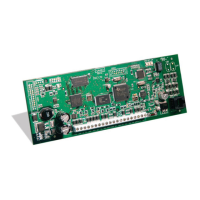
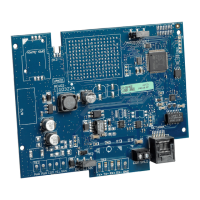
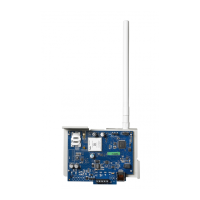
9.4 T-Link TL300 Programming
Step 1: Program the static IP address for the T-Link TL300 module in section [001].
Program 000.000.000.000 for DHCP
Step 2: Program the subnet mask for T-Link TL300 in section [002] if required.
This option will be ignored if the unit is set for DHCP (Section [001])
Step 3: Program the static IP address of the receiver (DRL3-IP line card) in section [007].
Step 4: If the receiver (DRL3 -IP line card) is on a different network segment than the
T-Link TL300 module, Program the gateway address associated with the T-Link TL300 in
section [008].
NOTE: This step is optional. Verify with the Network Administrator if this step is required.
Step 5: If a specific dial tone is required for the panel connected to T-LinK TL-300 T1/R1, refer to
section [071].


 To Next Page
 Loading...