
 Need help?
Do you have a question about the Ecom ECP2010 and is the answer not in the manual?
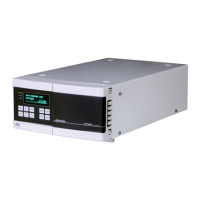
The ECOM ECP2010 / ECP2010H is an analytical HPLC pump designed for use in liquid chromatography systems in laboratory environments.
The pump is a double-acting unit equipped with main and auxiliary pumping blocks. The main pumping head features an inlet and outlet check valve. Smooth flow of the mobile phase is achieved through specially shaped driving cams, ensuring a steady operation of sapphire/ceramic pistons under back pressure, and precise control of motor rotation. The pump can operate independently as an isocratic pump. When connected to a compatible gradient box (sold separately), it functions as a gradient pump. If the gradient box is disconnected, the unit will indicate this when accessing menu items designated for gradient mode (e.g., Menu/Parameters/Concentration).
The ECP2010 is an analytical HPLC pump with a maximum operating pressure of 40 MPa (5800 psi, 400 bar), while the ECP2010H model offers a higher maximum operating pressure of 60 MPa (8700 psi, 600 bar). Both models provide a flow rate range of 0.02 to 10.00 ml/min. The pumping system uses two plungers with a 1/8" diameter connected in series, featuring a main piston stroke volume of approximately 62 µl and an auxiliary piston stroke volume of approximately 32 µl.
Accuracy and Repeatability:
Pressure Limits:
Other Specifications:
Operational Environment Conditions:
The ECP2010/ECP2010H pump offers a range of features for flexible and precise operation:
Keyboard Control: The front panel includes a display and a keyboard for direct control. Key functions include:
Installation and Initial Setup: The unit should be placed horizontally, with at least 10 cm space behind it, and away from strong magnetic fields. It is filled with isopropanol after manufacturing or service and requires rinsing and degassing with the mobile phase before first use. Inlet tubing connection varies for isocratic and gradient modes, with specific accessories provided. Outlet capillaries are used to connect the pump to the injector or column. The injector holder and column holder are mounted using Torx screws. Injection valves (Rheodyne and Vici types) can be mounted, with different hole spacings for each type.
Piston Backwash: Crucial when using buffers or crystallizing agents. This can be done manually or automatically.
Waste System Assemblage: The waste system is designed to prevent liquid accumulation and ensure smooth flow to a waste reservoir. It involves connecting tubing and connectors from the pump and, if applicable, the gradient box, column oven, and detector.
Gradient Programming: The pump supports up to 12 gradient programs, allowing control over concentration course and flowrate over time. Users can set high and low pressure limits and program termination options. Concentration changes linearly between steps, while flowrate changes immediately at the step time.
Pulsation Compensation: The unit offers pulsation compensation modes: OFF, FIXED (predefined speed), and LEARNED (optimal pump rotation speed based on learning). Learning must be initiated in the menu.
IO Configuration: Includes Ethernet settings (DHCP/STATIC IP, IP Address, Subnet Mask, Default Gateway) and an auxiliary external interface (IO INTERFACE) for analog and digital inputs/outputs, and a digital output switch.
Remote Keylock: Allows locking the keypad when the unit is controlled remotely via RS232 or Ethernet, with options to allow PUMP, PURGE, and FLOW functions.
Regular maintenance is essential for optimal performance and longevity of the ECP2010/ECP2010H pump.
Parts Replacement:
Calibrations:
Factory Settings: Allows partial or complete reset of the system. Users can access "PARAMETERS TO DEFAULT" to restore default unit parameters. "RESTORE FACTORY SETTINGS" enables restoring factory calibration for pressure sensor, flowrate, and gradient.
Troubleshooting: The manual provides a comprehensive troubleshooting guide for common issues such as leaking liquid, pressure pulsation, low flowrate, and error/warning messages. It suggests solutions like replacing seals or check valves, purging the pump, checking connections, and contacting a service center for electronic or mechanical failures. Diagnostics from PC records (e.g., Ecomac software) can help identify issues like bubbles or damaged parts by analyzing pressure course.
Cleaning and Decontamination: The unit surface should be cleaned with a dry or moistened cotton cloth. Check valves can be cleaned using ultrasound.
Storage and Transport: For long-term storage or transport, it is advisable to purge the unit with isopropanol and plug it. The unit door should be removed to prevent damage during transportation.
Periodic Controls:
 General
| Brand | Ecom |
|---|---|
| Model | ECP2010 |
| Category | Water Pump |
| Language | English |

 To Next Page