AP30 Phasing Conventions
PhaseTrakker AP30
50
AP30 Phasing Conventions
There is variation in the terms used to label phase sequence and phase angles
among different utilities supplying three-phase power. For example, some utili-
ties refer to phases in ABC sequence and some use ACB. Some use negative an-
gles to refer to phase lag and some use positive angles. Some use angles in the
±180° range and some prefer the 0° to 360° range.
ABC Sequence
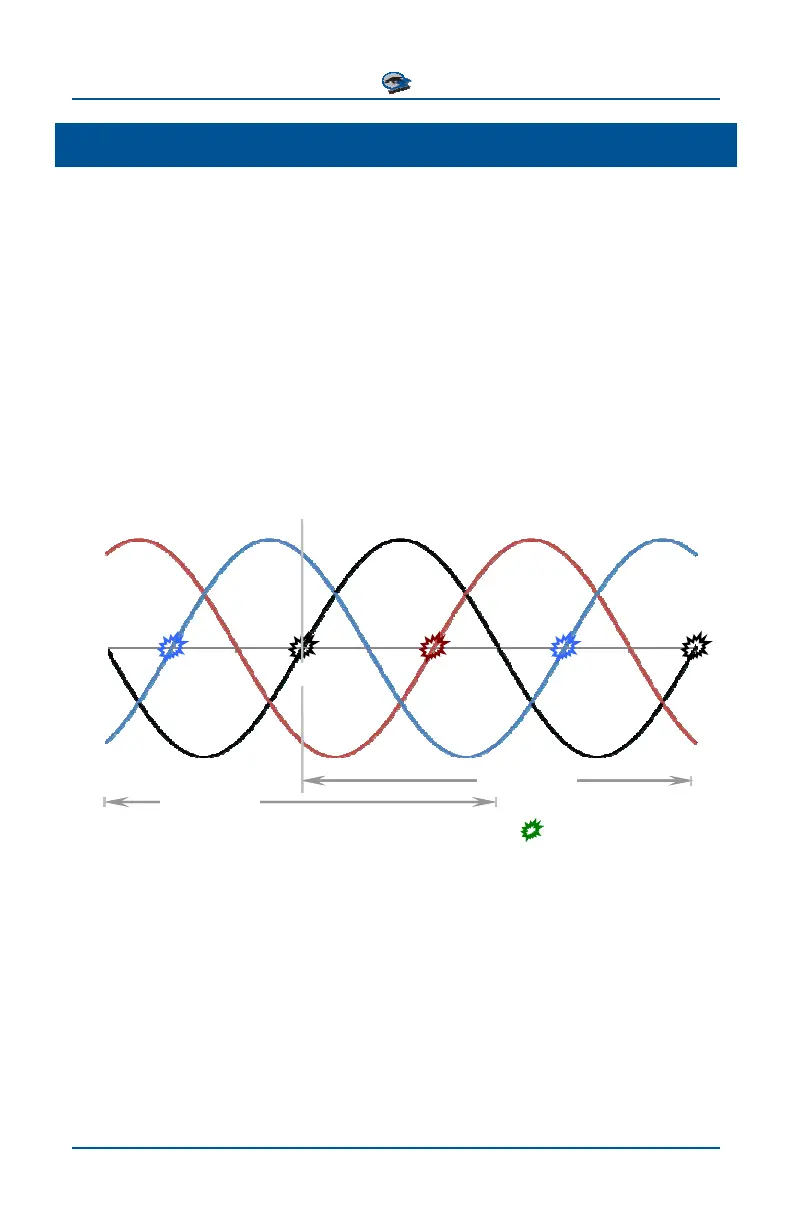
ABC sequence is the most commonly used to label phases. The order of the volt-
age waveforms through time are labeled A, B, and C. The AP30 detects the
zero crossing of a voltage waveform as it rises to its positive peak. By conven-
tion in the AP30, the first waveform is always A and its zero crossing rising is
always 0°.
Three-Phase Voltage Waveforms
Zero Crossing RisingZero Crossing Rising
Voltage
V
A
V
B
V
C
+
-
ABC Sequence
0°
+360° Range
±180° Range
V
B
lags V
A
by 120° V
B
leads V
A
by 240°
V
C
leads V
A
by 120° V
C
lags V
A
by 240°
The terms lag and lead refer to the relative timing of the zero crossings, and the
amount of lag or lead is expressed by the degrees separating the zero crossings
for the voltage waves. Because the sine waves are cyclic and continuous, a wave
can be viewed as either lagging or leading another. Lag can be indicated with
either negative or positive phase angle, according to which convention is pre-
ferred.



 To Next Page