another. That year Boise, Idaho received the first
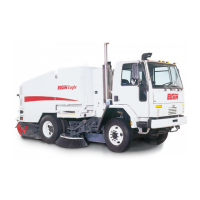
motorized street sweeper (Figure D-1), manufac-
tured by Elgin Sweeper.
As society changed, the demands on sweepers also
changed. Litter, dust, leaves and grass still remain.
Add to that sand and salt from the winter’s snow
removal and metal and rubber from cars and
trucks. Airport runways must be kept immaculate;
a small piece of metal on a runway can cause havoc
with a jet engine. Parking lots and garages have
replaced stables. Environmental concerns mean not
only cleaning the streets, but keeping the collected
debris out of the air and waterways.
In 1964 Elgin introduced the most popular sweeper
ever, the Pelican, a mechanical sweeper. Elgin’s
first vacuum sweeper, the Whirlwind, entered the
market in 1969 and in 1983 the Crosswind, a recir-
culating air sweeper joined the ranks of Elgin
street sweepers. Next, in 1988 came the Eagle, a
four-wheel mechanical sweeper that can be driven
at highway speeds. The year 1996 saw the addition
of the Fast Sweeping Crosswind FSX and the
GeoVac to the product line.These sweepers answer
the needs of the modern community.
The acquisition of Vactor Manufacturing by Federal
Signal Corporation, Elgin Sweeper's parent compa-
ny, added the vacuum sweeper, Sunvac III, to the
Elgin product line in 1994.
MECHANICAL/BROOM SWEEPERS
Mechanical, or broom, sweepers remove debris by
sweeping it onto a conveyor. The conveyor carries
the debris to a hopper. The No-Jam™ hopper con-
veyor of Elgin Eagle was originally patented. This
revolutionary design sweeps debris up onto the con-
veyor, eliminating the problems of jamming.
EAGLE
The Eagle offers the patented No-Jam ™ conveyor
of the world’s most popular sweeper, the Elgin
Pelican, in a 4-wheel sweeper capable of travelling
at highway speeds between sweep locations. The
Eagle picks up large objects, such as branches, hub
D-3
DESCRIPTION


 To Next Page