ECH 200 BD
27/76
Examples:
Cycle 0:
• Set point: SET(COO)
• Hysteresis: SET(COO) + C03
Cycle 1:
• Set point for cycle 1: SET(1) = SET (COO) – AO(1)
• Hysteresis for cycle 1: SET(1) + C03 + AO(1) = SET(COO) - AO(1)
+ C03 + AO(1) = SET(COO) + C03
Cycle 2:
• Set point for cycle 2: SET(2) = SET (COO) – AO(1) – AO(2)
• Hysteresis for cycle 2: SET(COO) + C03
Cycle 0:
• Set point: SET(HEA)
• Hysteresis: SET(HEA) - C04
Cycle 1:
• Set point for cycle 1: SET(1) = SET (HEA) + AO(1)
• Hysteresis for cycle 1: SET(HEA) - C04 + AO(1) = SET(HEA) - AO(1)
+ C04 + AO(1) = SET(HEA) + C04
Cycle 2:
• Set point for cycle 2: SET(2) = SET (HEA) + AO(1) + AO(2)
• Hysteresis for cycle 2: SET(HEA) - C04
It is useful to notice that the start temperature in both modes remains constant for each cycle even when the adaptive
function is enabled.
This increases the range between the set point and start temperatures, reducing the number of starts/stops of the
compressor.
7.1.3 Set point regression (for ET≥MT)
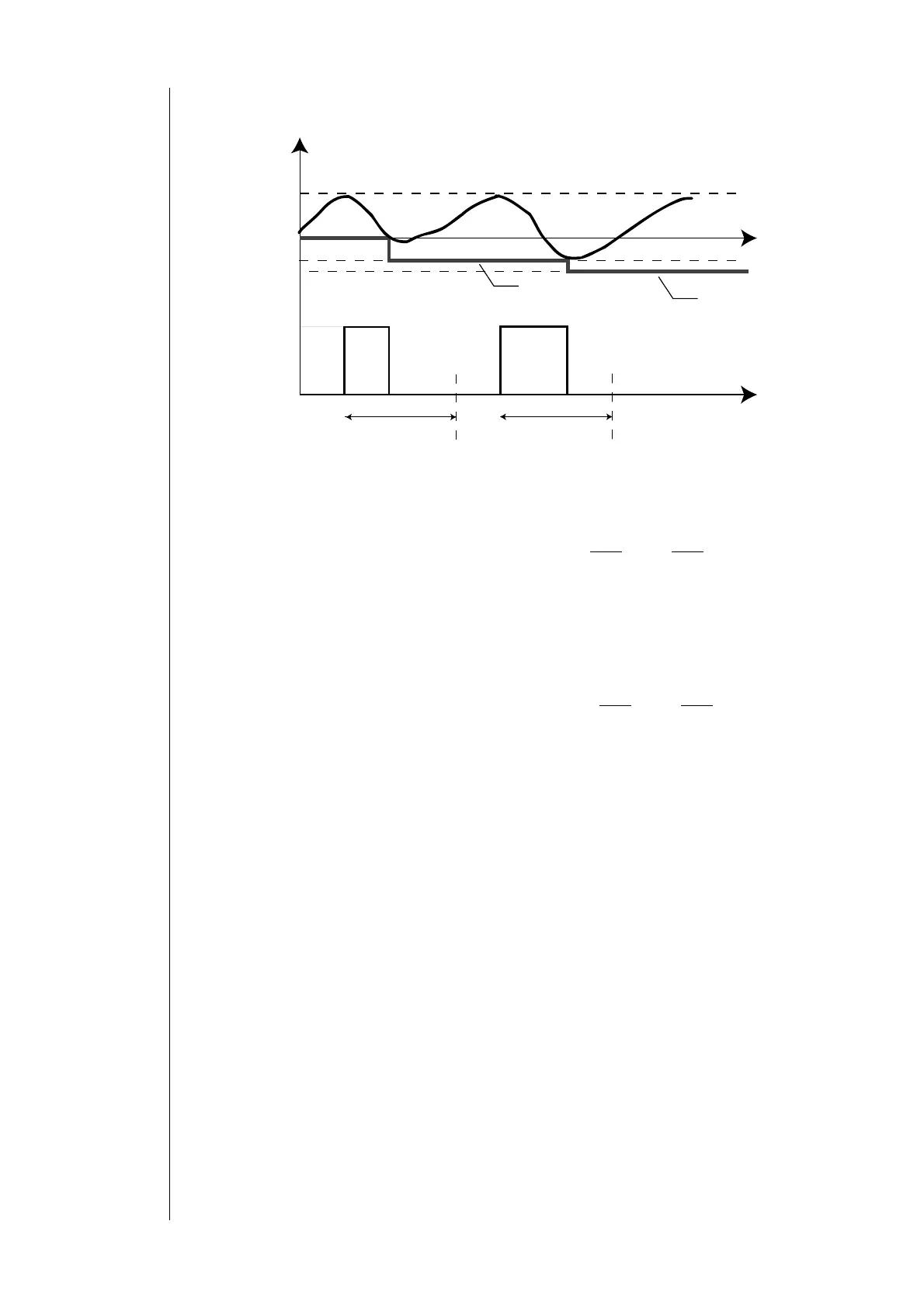
If the cycle time is long enough (and not above MT), the regression of the actual set point occurs: the set point is changed
by C11 for each C12 range (starting from the beginning of the cycle).
• In Cooling mode, the set point (applicable to cycle N) is increased:
After C12: SET(N) + C11
After 2*C12: SET(N) + 2*C11
And so on, up to limit value of SET(COO)
• In Heating mode, the set point is reduced, as explained above, down to the limit value of SET(HEA).
This produces a balancing of the “adaptive” function with long cycle times because longer cycle times are compatible with
those of the compressor.
Example: cooling
Cooling Mode
Heating Mode
ET
MT
ET
MT
OFF
ON
SET
set+Int
AO
Co m p.
AI1
SET 1
SET 2


 To Next Page