Common notes
ISP (In-System Programming)
Definition
In-system programming allows programming and
reprogramming of device positioned inside the end system.
Using a simple interface, the ISP programmer communicates
serially with the device, reprogramming nonvolatile memories
on the chip. In-system programming eliminates the physical
removal of chips from the system. This will save time and
money, both during development in the lab, and when updating
the software or parameters in the field.
Target device is the device (microcontroller, PLD, etc…),
which is to be in-system programmed.
Target system is the physical Printed Circuit Board (PCB),
which contains the device to be in-system programmed.
ISP programmer is programmer, which has in-system
programming capability (for example SmartProg, T51prog,
PIKprog+…).
General rules for in-system programming
We recommended respect following rules to avoid damage PC,
ISP programmer, and target device or target system:
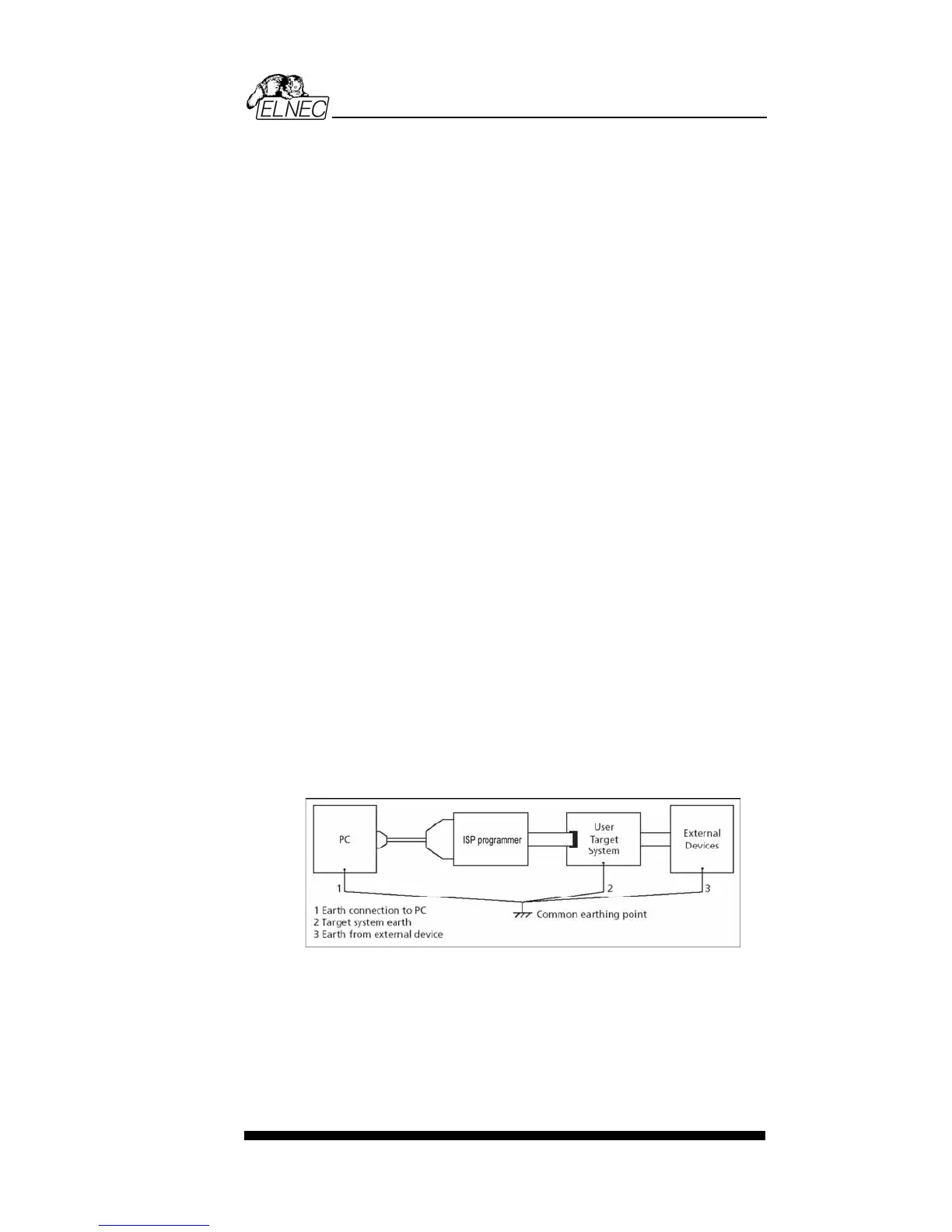
• Ensure common earth point for target system, ISP
programmer and PC.
• For laptop or other PC that is not connected to common earth
point: make hard - wired connection from laptop to common
earth point (for example use LPT or COM port D –
connector).
• Any devices connected to target system must be connected
to common earth point too.
Direction of connect ELNEC ISP
programmer to target system:
During in-system programming you connect two electrical
devices – ISP programmer and target system. Unqualified
connection can damage these devices.
151


 To Next Page