UFM Series 6
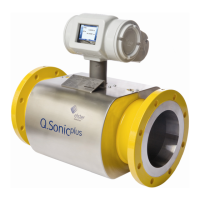
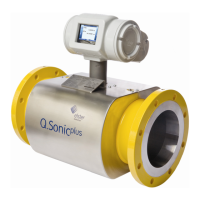
Q.Sonic-plus
Operation and Maintenance
The sample rate is programmable to be anything between 1 and 100Hz.
However, the actual sample rate may be lower than the programmed value
since, particularly with large size meters, the travel times of the ultrasonic
pulses in the gas do not allow for the programmed sample rate. The UFM
will then adjust the sample rate to the highest possible value. The highest
possible sample rate is not necessarily the best setting for optimum
performance. Although the sample rate is not critical, a value between 8 and
25 samples/second is recommended.
8.2.2 Performance
Performance is the pulse acceptance rate, expressed as a percentage for
the pulses transmitted each second. Each transducer transmits a number of
pulses each second. To be accepted as a valid received pulse by the signal
processing system, each pulse must arrive within a small time window, be of
sufficient strength, and match a unique waveform signature. The percentage
of accepted pulses is shown as an average value of all measuring paths,
and for each individual path.
8.2.3 Velocity of Sound
The UFM calculates the speed of sound in the gas, based on the measured
travel times and the programmed spool piece geometry. This value may be
compared to the (theoretically) expected value, for example as calculated
using the AGA-10 equations of state. The difference between measured and
expected values can be as little as 0.25%, provided that gas composition,
temperature, and pressure are precisely known.
8.2.4 Gas Velocity (Zero Flow Measurement)
When there is no flow through the meter, i.e. the block valve(s) are closed,
the corrected gas velocity should randomly fluctuate between 0.025 m/s
and average very close to zero. During a sunny day the warm walls of the
meter will cause small thermal convection currents to circulate inside the
meter. The ultrasonic meter may actually measure these very slow currents
as an increase in the random fluctuations.


 To Next Page