3
21
Etac / Cross 5 / www.etac.com
Etac’s wheelchairs are tested in accordance with ISO
7176-19 (see ”Tests and guarantees” section in the
manual).
Etac recommends in the following order:
1) The user transfers to a seat in the vehicle and uses the
vehicle’s 3-point belt while travelling. The wheelchair
is then placed in the boot or safely in the back seat so
that it cannot overturn or roll.
• If possible, the wheelchair should be placed in the
boot.
• If the wheelchair is placed in the back seat, make
sure it can not overturn or roll. If possible secure the
wheelchair with the car’s safety belt.
2) The wheelchair is secured facing forwards in the vehicle
as per this manual, the user uses a separate 3-point
belt that is secured in the vehicle.
This is the way the wheelchair is tested and approved according
to ISO 7176-19:
- Clamping device UNWIN_WWR/ATF/K/R according to ISO
10542
- Three point strap 907523, Klippan Safety AB.
- Parking brakes activated
- Anti-tip guards activated
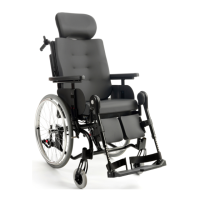
- Head support bracket 3A and head support. (Cross 5/5XL)
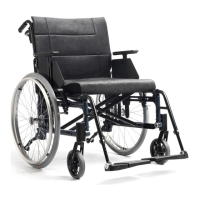
- Cross bar (Cross 5XL)
- Rear wheels with handrims.
Securing
• Securement points rear must be used.
• Restraining device must not be put through the wheels
or around the back tubes.
• Accessories that can be detached without tools must be
removed and clamped
• If head support is mounted other than with head sup-
port bracket 3A, cross bar must be used.
• Cross 5XL must have cross bar regardless of which way
the head support is mounted.
3) According to directive 2001/85/EC, appendix VII, point
3.8.3. there are specially marked wheelchair locations
in vehicles that permit transport with a wheelchair
facing in the opposite direction of travel. If this means
of travel is used, the user/carer must be aware while
travelling, prepared for sudden movements and have
the capacity to maintain a safe sitting position throug-
hout the entire journey. The user’s disabilities must not
be of such an extent that he/she is not able to hold
onto the handles fitted in the vehicle when there are
changes of speed or direction.
- Parking brakes activated.
- Anti-tip guards activated.
- Head support.
- Positioning belt should be used.
- Accessories that can be detached without tools must be
removed and clamped.
Transportation in vehicles
User manual


 To Next Page