146 Eos Family Operations Manual
LDMX or “low-DMX” is the DMX address for the second half of any 16-bit channel. If used in
Coarse/ Fine determination, the DMX channel defines the “Coarse” adjustment and the LDMX
defines the “Fine” adjustment.
1. Use the [Page] keys to navigate to any parameter that you wish to alter the size of. The system
defaults to 8-bit for any new parameter.
2. When selected, press {Size}. This will toggle the parameter from 8-bit to 16-bit. If 16-bit is
selected, the system automatically displays a LDMX option. This value can be altered.
3. Enter the desired address for the DMX and/ or LDMX addresses using the keypad.
To alter theHome settings for any parameter:
You can define the value for any parameter’s “home” value.
1. Click on the “Home” column of the desired parameter.
2. Enter the desired home value (0 through 255 for 8-bit, and 0 through 65535 for 16-bit) using
the keypad.
To enable theSnap setting for parameters:
You can enable snap for parameters to exempt them from cue timing, so they snap to their new
value. For more information about snap, see Snap Parameters (on thefacing page)
1. Use the [Page] keys to navigate to the “Snap” column of the desired parameter.
2. Click in the ‘Snap” column for the selected parameter to enable.
Range editing a parameter
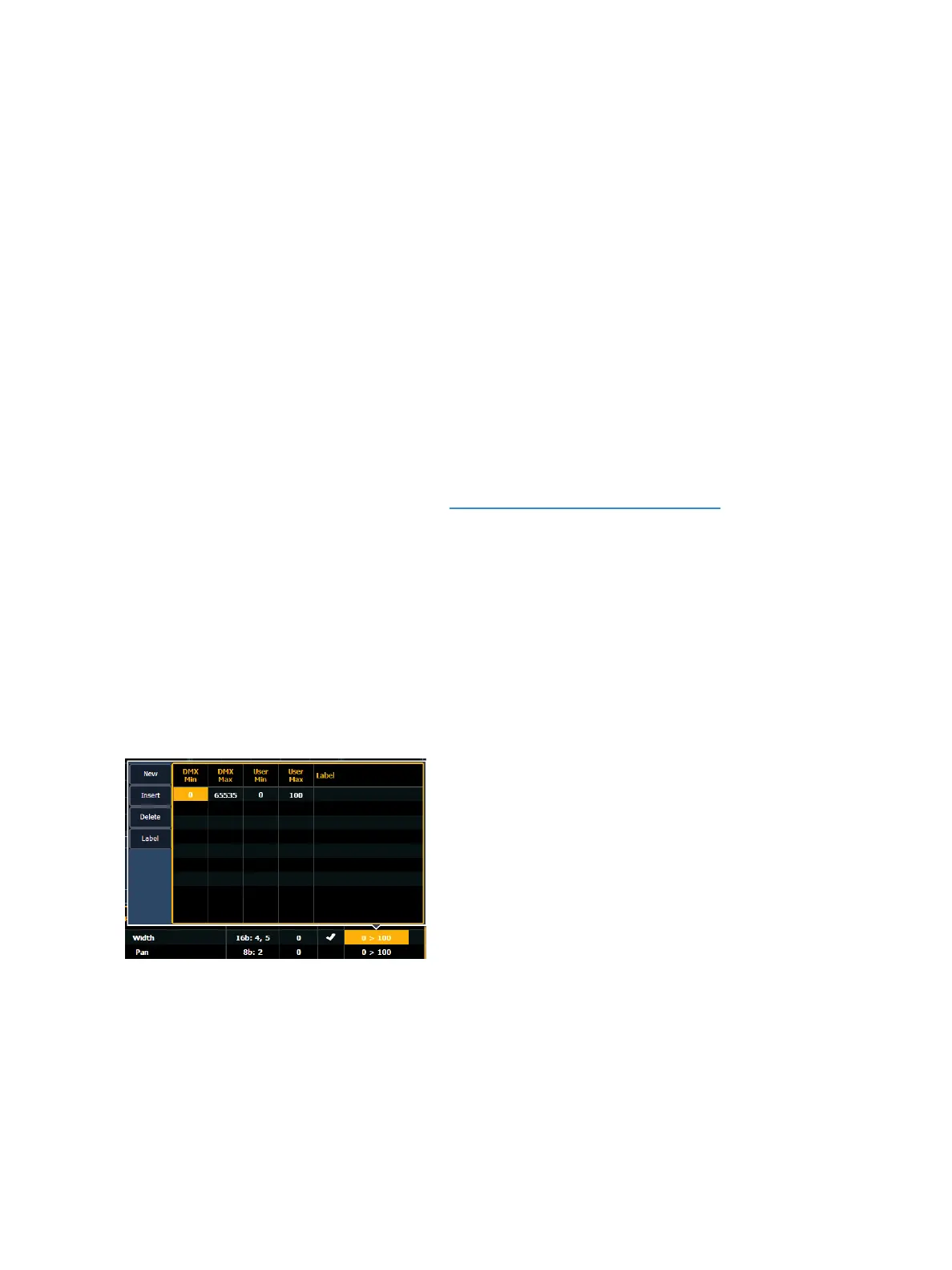
You can enter the operational ranges for specific slots within any specific parameter (such as color
scroller, color wheel, gobo wheel, and so on).
For example, if the parameter were “Gobo Wheel”, and the fixture included a four-slot gobo wheel,
you can use ranges to determine the minimum/ maximum values for each of those slots. You can
also label the slots and define the minimum/ maximum values that will appear in the channel display
for that parameter.
To definetherange values for any parameter:
1. Use the [Page] keys to navigate to the parameter that you want to add ranges to.
2. Click on the range. The range window will open.
3. Determine the total number of slots required by the parameter. Besure to include “open”
slots when needed.



 To Next Page