358 Ion Classic User Manual
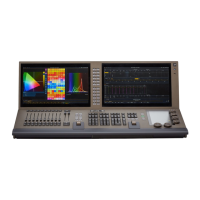
Element 2 and Classic Paging
On Element 2 and Element Classic, you can page the faders by holding down the {Page Subs}
softkey in the Live display. The bump buttons will light up in green, and the bump buttons that
correspond to the currently selected pages will flash. Press the corresponding bump button to
go to that page. The fader status display will change to show the fader pages. See Paging
Submasters (on page1) for more information.
On Ion Classic, holding down [Fader Control] to use the bump buttons on an external wing.
Playback Fader Controls
The following buttons are found in the Master Fader controls or in the Fader Page controls
area of your console. See
Playback Controls (on page352)
In Ion Classic and Element Classic, many of the buttons mentioned below exist as softkeys. In
order to have access to some of these keys, press [Fader Control] (Ion Classic) or [Live] {Fader
Control} (Element Classic). The softkeys will change to display the fader control keys. You may
press [More SK] if the green LED is illuminated, to view additional fader control buttons.
The following controls are available:
Load (
Selected Cue (on page352)
)
Go (
Using [Go] (below)
)
Stop/ Back (
Using [Stop/ Back] (on the facing page)
)
Blackout (
Using Blackout and Grandmaster (on the facing page)
)
Grandmaster (
Using Blackout and Grandmaster (on the facing page)
)
Go To Cue 0 (
[Go To Cue 0] (on the facing page)
)
Assert (
Using Assert (Playback Button) (on page360)
)
Timing Disable (
Using Timing Disable (on page360)
Freeze
Using Freeze (on page360)
)
Stop Effect (
Using Stop Effect (on page361)
)
Rate Override (
Using Rate Override (on page361)
)
Manual Override (
Manual Override (on page363)
)
Off (
Releasing Content From a Fader (on page363)
)
Release (
Releasing Content From a Fader (on page363)
)
Fader Page (
Changing Fader Pages (on the previous page)
)
Using [Go]
The [Go] button is used to execute the cue currently in the pending file of the associated
fader. When [Go] is pressed, all parameters assume their required positions in the recorded
times, unless they have been recorded with manual timing. When a cue has manual timing
values stored with it, the fader will set itself to zero when [Go] is pressed, or you may set the
fader to zero before you press [Go].
If a channel parameter is in a transition state when a new cue is activated on the same
playback fader, that parameter will continue its initial instruction in its remaining time unless it
receives a new move instruction in the incoming cue. If a new instruction is provided, the
parameter will calculate its new target and the time to get there for a seamless course
adjustment. If a parameter in transition has no new instruction in the incoming cue, it will
continue its fade, using the original timing provided.
If a channel parameter is in a transition state when a new cue is activated on a different
playback fader, and that parameter receives a move instruction, even if it is exactly the same
instruction the parameter currently has, it will recalculate the destination and arrival time
according to the information from the new cue.


 To Next Page