Need help?
Do you have a question about the F.u.n.k.e. FSG 90 and is the answer not in the manual?
Crucial safety instructions to prevent hazards during operation.
Explains the meaning of warning symbols used in the manual.
Overview of the FSG 90 VHF/AM Transceiver System manual.
Details on the different models of the FSG 90 System available.
Describes suitable environments and uses for the FSG 90 transceiver.
Key features and operating modes of the FSG 90 transceiver.
Compliance and approval details for the FSG 90 system.
Information regarding national operating licenses for VHF/AM use.
Lists the equipment included and required for the FSG 90 system.
Details various optional accessories available for the FSG 90 system.
Information on MTBF and MTTR for the FSG 90 system.
Important tips and considerations for using microphones with the FSG 90.
General advice for installing the FSG 90 transceiver into an aircraft.
Procedure for unpacking and inspecting the FSG 90 equipment.
Recommended pre-installation test for the FSG 90 radio.
Specific requirements and considerations for FSG 90 transmitter modulation.
Guidance on physical installation, including compass deviation.
General guidelines and best practices for aircraft wiring.
Steps for verifying installation and radio functions after mounting.
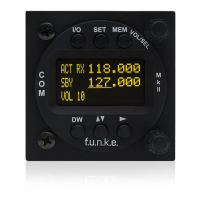
Describes the switches, buttons, and indicators on the FSG 90.
Detailed explanation of each control and its function on the FSG 90.
How to read and interpret the FSG 90's frequency display.
Identifies and describes the connectors on the rear of the FSG 90.
Steps to access the SET-UP menu without a password.
Procedure to access the SET-UP menu using a password.
How to safely exit or interrupt the SET-UP process.
Setting the automatic squelch level for optimal reception.
Optimizing microphone input sensitivity for clear voice transmission.
Setting the intercom audio volume for clear communication.
Configuring the sidetone volume for transmit monitoring.
Setting the headphone volume during reception.
Choosing between 8.33 kHz and 25 kHz channel spacing.
Procedure for removing stored frequencies from memory.
Enabling or disabling external AF audio via the aircraft speaker.
Restricting frequency selection to pre-programmed channels or allowing free selection.
Setting the transmitter blocking feature during receive.
How to set a password to protect SET-UP adjustments.
Restoring the device to its original factory default settings.
Basic operating procedures for the FSG 90 transceiver.
Steps for powering on and setting frequency and volume.
How to operate the FSG 90 in receive mode.
Detailed instructions for transmitting using the FSG 90.
How to store and recall new frequencies or channel names.
Understanding and adjusting the squelch function.
Using the intercom feature for pilot and crew communication.
Connecting and using external audio sources.
Monitoring the aircraft's power supply and battery status.
Operating the FSG 90 under low voltage or emergency conditions.
Summary of general technical data for FSG 90 models.
Physical characteristics and fuse requirements of the FSG 90.
Lists regulatory approvals and certifications for the FSG 90.
Detailed technical specifications for the FSG 90 receiver.
Detailed technical specifications for the FSG 90 transmitter.
Classification based on compliance with EUROCAE ED-14C / RTCA DO-160 C.
Table showing ICAO frequency and channel name pairings.
European Technical Standard Order (ETSO) authorization document.
Certificates from the German Federal Supervisory Authority for Air Navigation.
Declaration of conformity to EU directives for radio equipment.
FCC authorization grant for the FSG 90 transceiver.
 General
| Brand | F.u.n.k.e. |
|---|---|
| Model | FSG 90 |
| Category | Transceiver |
| Language | English |

 To Next Page