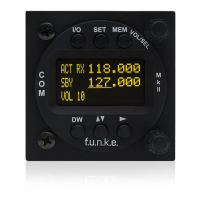
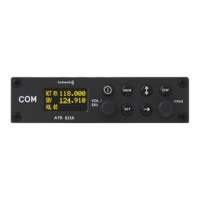
FSG 90 System
3 Installation
December 2014 FAV_D10024 15
b) In Receive Mode set the VOL control to mid position. On all channels within 118 ...
136.975 MHz, almost identical, strong, continuous acoustic noise must be audible.
c) Receiver sensitivity on all channels must comply with technical data (make
sensitivity tests to cover the whole frequency range).
d) Switch ON the Squelch (push SQ button again). The squelch threshold (depending
on SET-UP pre-setting) shall be within 0.5 µV and 5 µV / 50 Ohms (vary signal
generator output level).
e) Connect a 50-Ohm Wattmeter and a 20 or 30 dB throughline RF attenuator pad.
Key the transmitter and check RF output level (more than 6 W carrier or more than
10 W carrier for FSG 90-H1 model).
f) Adjust audio generator to 1,000 Hz (via attenuator for dynamic microphone or
directly via decoupling capacitor) connected to
Amplified/Carbon Microphone Input
With 100 mV rms input, the transmitter shall achieve more than 70% AM. Increase
AF input to 1.0 V rms, observe modulation envelope, no overmodulation shall occur;
depth of modulation must remain less than 95% AM.
Dynamic Microphone Input
With some 1 mV rms input, the transmitter shall achieve more than 70% AM
(depending on SET-UP pre-setting). Increase AF input to 10 mV rms and observe
modulation envelope. No overmodulation shall occur; depth of modulation must
remain less than 95% AM.
3.4 Particular Remarks to FSG 90(X) transmitter modulation
For the combined 8.33 kHz and 25 kHz channel spacing airband radio technology, highly
demanding, and specific requirements shall be comprehensively considered as follows:
1. Voice modulation with its typical dynamic peaks (fast and large level changes) shall
modulate the transmitter with peak AM depth of less than 85%.
2. Factory setting of the very specific FSG 90(X) voice processor results in a
remarkable AVERAGE of approximately 80% AM depth (voice and Sine
modulation!). Thus, optimized usage of the RF carrier is achieved.
3. Do not change this setting, otherwise the stringent Transmitter Spectrum Mask is no
longer maintained.
4. The FSG 90 System incorporates a special VOICE PROCESSOR, which is matched
best to meet the requirements of the particular environmental noise level situation.
a) This ensures a always loud and clear transmitter modulation, under
consideration of specific test requirements.
b) Due to the voice processor voice signal transfer is IDENTICAL in both the
8.33 kHz and in the 25 kHz channel spacing mode.
c) Even under these very specific conditions, fulfilment of the critical, highly
demanding Spectrum Mask is achieved.
5. Although due to the specific voice processor compression of modulation peaks,
when tested with maximum sine wave modulation signal, a conventional testing of
"standard modulation distortion measurements" is possible. This does however refer


 To Next Page