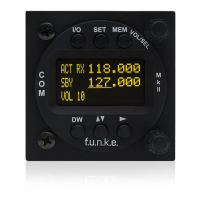
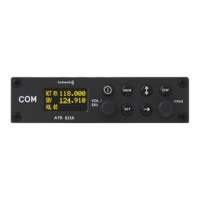
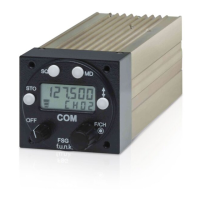
FSG 90 System
2 General Description
6 FAV_D10024 December 2014
The automatic AM/FM Squelch (threshold adjustable in 4 levels, SET-UP) and the
normally active transmitter blocking during Receive are disabled by pushing the SQ
button, and enabled when the SQ button is pushed again.
An audio low pass filter for areas using Climax operation in 25 kHz spacing is
incorporated.
Separate Audio amplifiers power the speaker (4 Watts / 4 Ohms or 8 Watts / 2 Ohms),
and the headphones (100 mW / 600 Ohms).
The solid-state transmitter is wideband tuned from 118 to 137 MHz and delivers at least
an RF carrier power of 6 Watts or 10 Watts for the FSG 90-H1 model.
Transmit frequency / channel name is tuned simultaneously with Receive frequency /
channel name (Simplex operation).
A keyed transmitter is indicated by a transmit symbol at the LC display.
Two independent microphone inputs (separate pins) allow universal accessory
operation:
For powered aircraft use Standard Carbon, amplified Dynamic or Electret
microphones,
For gliders, portable, vehicle mobile and fixed base operation use non-amplified
Dynamic microphones.
The microphone inputs may also be continuously activated. This allows in Receive
continuous intercommunication (no additional accessories needed) between pilot and
crew (intercom wiring harness), using headsets.
A separate AF input allows interconnection of external audio source(s) especially in
aircraft using other COM, VOR/LOC, DME, MKR and/or electric variometers. This allows
signal monitoring during Receive by speaker and/or headphone.
30 mA current consumption saving can be achieved in standby mode (Squelch ON),
when the FSG 90(X) is used e.g. in portable cases or installations, where no external
audio is required for speaker output. However listening through the headphone remains
possible. This external AF OFF function may be selected in SET-UP. This reduces the
standby current consumption to only 85 mA and will extend battery supplied operating
time significantly.
The transceiver can be supplied either directly from a 12 - 14 Vdc A/C bus, or through a
suitable DC regulator from 28 Vdc-buses.
In aircraft (or portable cases) without on-board electric power generation system (UL,
Glider etc.), operation from a 12 Vdc battery (min. 6 Ah) is suitable.
The DC supply voltage is monitored automatically. When supply drops below 11 Vdc, the
Supply Indicator at the LC display starts blinking as a low supply warning.
Below 8.5 to 9.5 Vdc, the FSG 90(X) turns OFF itself automatically, and will resume
operation with supply above 9.5 to 10 Vdc. The last used settings remain active.
A voice processor is incorporated to achieve identical acoustic voice quality during
Transmit and Receive, as well as Audio Levelling in Receive, and in addition prevents
overmodulation. Usual testing employs sinusoidal tone signals only; this feature
especially considers the specific characteristic of the voice. It ensures also VERY HIGH


 To Next Page