Protective clothing
Personnel operating hand-held, high-pressure water cut
-
ting or cleaning equipment and those working nearby
should wear the protective clothing and safety devices
described in this chapter.
FLOW recommends that work-site safety personnel ap
-
prove all safety equipment and clothing for everyone
working around waterjet equipment.
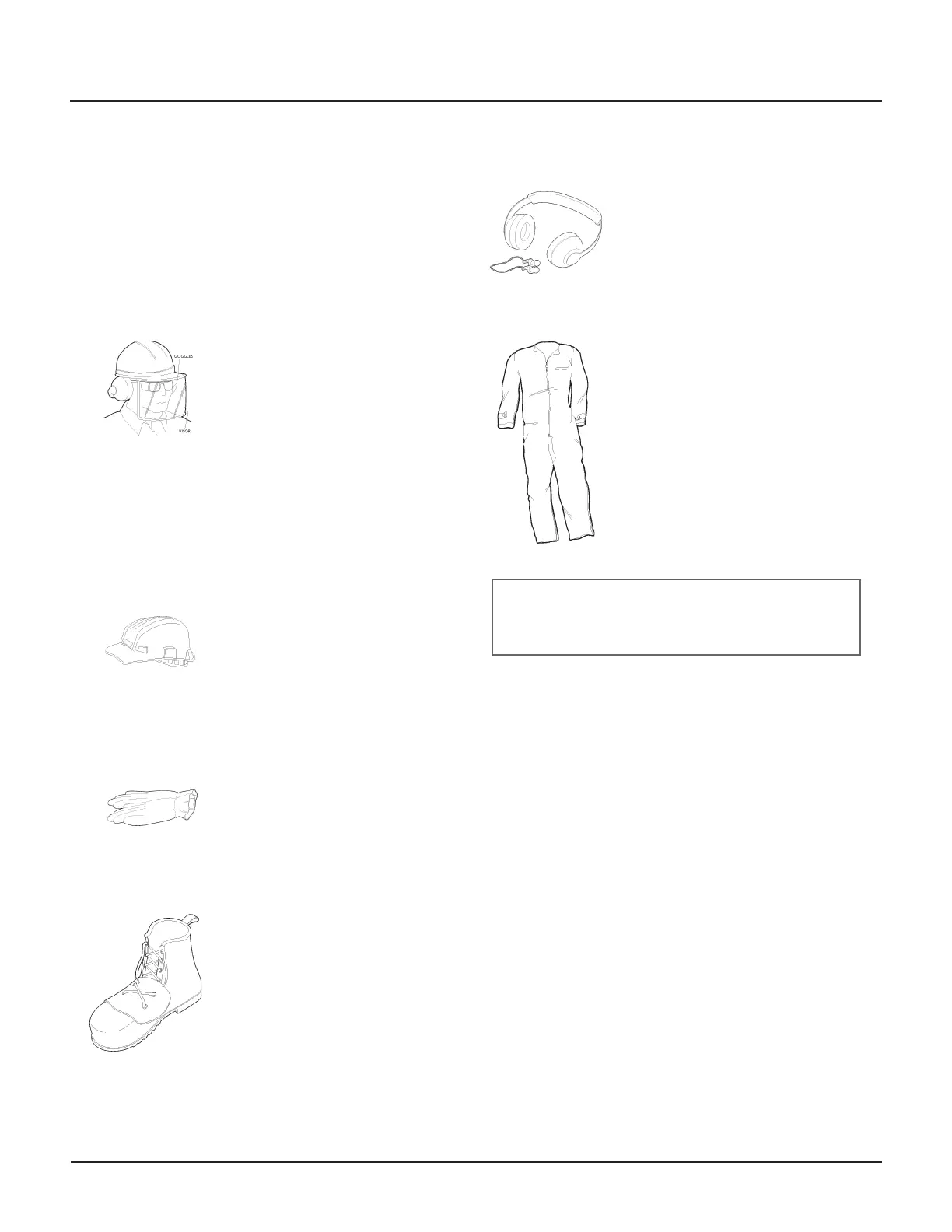
Eye protection
•
At a minimum, operators must
wear safety glasses with side
shields and a visor, or goggles and
a visor, to guard against spray and
flying debris.
•
All eye protection shall meet ap
-
propriate ANSI requirements for
that type of eye protection.
•
Some states and countries have
their own eye protection rules
that must be followed.
Head protection
•
Helmets must be worn at all
times by all personnel within the
work area.
•
Helmet material must withstand
mechanical shock to 10 G in 8 ms
without fracturing.
Hand protection
•
The operator must wear gloves
at all times. Leather gloves are
preferred.
Foot protection
•
Safety footwear with steel
toe-caps 0.02-in. (5 mm) thick
(minimum) must be worn. The
toe cap must cover at least 30%
of the footwear length.
•
For some applications, footwear
must be equipped with metatar
-
sal guards to provide instep pro
-
tection.
Hearing protection
•
Operators and other personnel
exposed to noise levels of more
than 90 dBa for more than
1 hour must wear suitable ear
protection. Ear plugs and muffs
are usually adequate.
Body protection
•
Waterproof garments only protect
the operator from spray and flying
debris. They
DO NOT provide any
protection from direct jet impact.
WARNING
NEVER point a waterjet cutting or cleaning tool
at yourself or at any person. Do not aim any
waterjet tool at anything you do not want to cut.
18 | M-390 © Flow International Corporation
HYPERJET™ 94i-S AND 94i-D PUMPS


 To Next Page