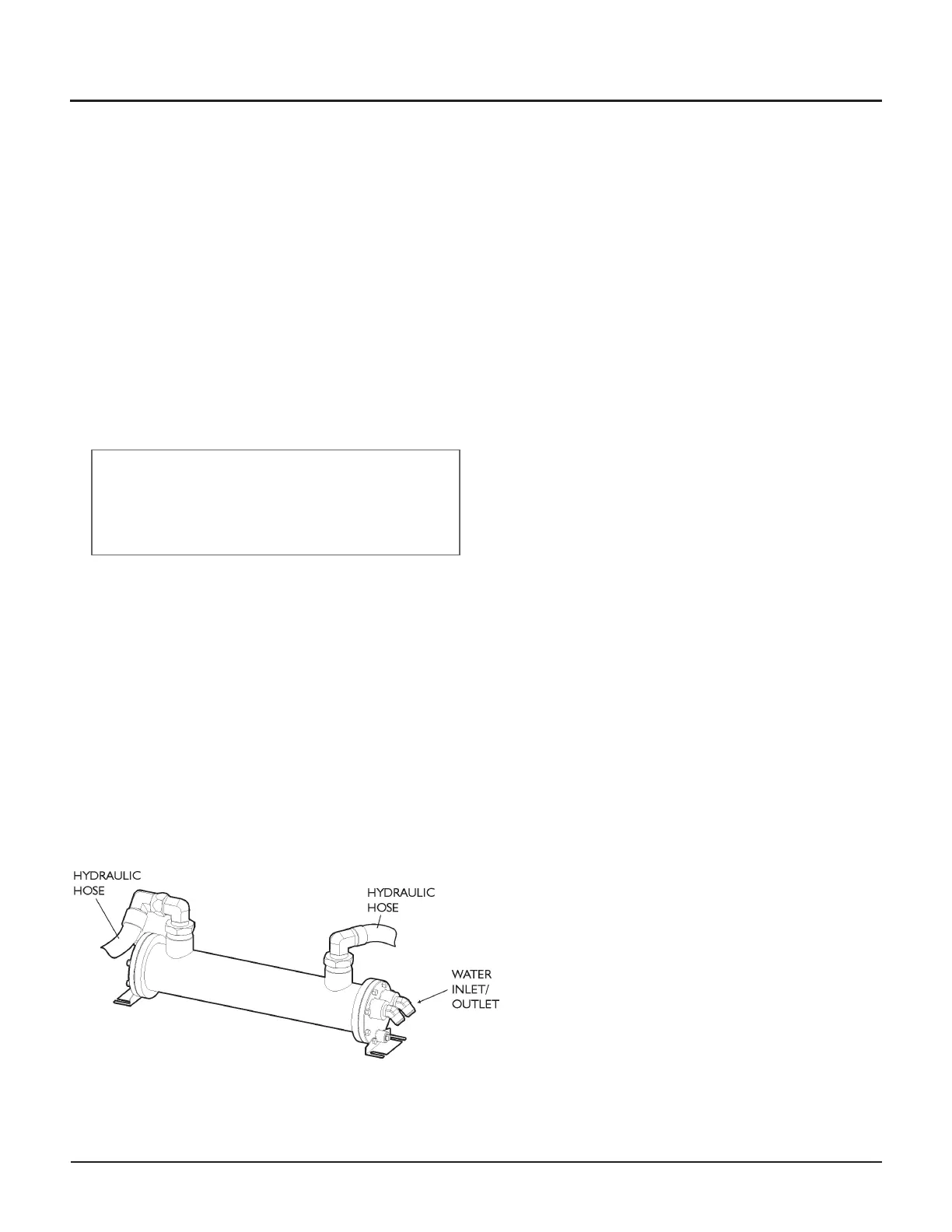
Servicing the heat exchanger
This service procedure is a test to see if the heat
exchanger is leaking water into the oil system. The
oil-to-water heat exchanger controls heat build-up in
the hydraulic oil. The heat exchanger requires no rou
-
tine maintenance.
If the hydraulic oil looks milky but doesn't contain air
bubbles, the oil is contaminated with water. This can be
caused by contaminated oil in the reservoir, excessive
condensation in the reservoir, a missing reservoir filler
cap, or a leaky heat exchanger.
Note: A continual rise in oil level is a sign of cata
-
strophic heat exchanger failure.
Service steps
WARNING
Place the main electrical disconnect in the OFF
position and bleed down all high-pressure lines.
Place an Out of Service tag on the main electrical
disconnect and lock it out. Failure to do so can result in
equipment damage or injury to personnel.
1. Shut down the system.
2. Drain the contaminated oil from the reservoir. If you
see a large amount of water in the oil, the hydraulic
oil system must be completely drained to remove all
water, including intensifier, hydraulic pump, filter,
and hoses.
See Checking the hydraulic oil and Cleaning a con
-
taminated hydraulic system.
3. Disconnect the water hoses from the heat
exchanger.
4. Disconnect and plug the hydraulic oil lines. Hold the
heat exchanger level, and use a drip pan and rags to
catch dripping oil.
5. Remove the bolts that hold the heat exchanger to
the support and move the heat exchanger to a work
-
bench.
6. Plug one of the water ports and insert an air line fit
-
ting into the other.
7. Top off the oil level in the heat exchanger.
8. Connect an air line to the fitting. The air line must
be regulated to a maximum of 150 psig (10.3 bar)
air pressure, and have an on/off valve within easy
reach.
9. Watch the oil ports for air bubbles while slowly
opening the air valve and pressurizing the heat
exchanger. If the heat exchanger is leaking, you'll see
bubbles within a few seconds.
•
If the heat exchanger is defective, repair or re-
place it.
•
If the heat exchanger is OK, remove the fittings
and reinstall the heat exchanger.
•
Repeat Steps 3 through 9 for the second heat
exchanger.
•
If the heat exchanger is OK, water in the oil
was probably caused by putting contaminated
oil into the reservoir, excessive condensation in
the reservoir, or a missing reservoir filler cap.
See Checking the hydraulic oil.
10. Fill the hydraulic oil reservoir until oil is visible in the
sight gauge (see Chapter 1 for a list of recommended
oils).
CAUTION
You must add oil to the reservoir
AND
hydraulic pump case before operating the
pump or you will SEVERELY damage the system.
52 | M-390 © Flow International Corporation
HYPERJET™ 94i-S AND 94i-D PUMPS


 To Next Page