Owner’s Manual Page 140Prelaunch and Underway - Section T
T - 11 RETURNING TO SHORE
A. Docking
Always approach the dock slowly. Think before acting.
Ifyouarewonderingwhetheryourboatwilltina
space against a dock, remember that pilings are often
(but not always) spaced 10 feet apart.
Remember that it is easier to control a boat in reverse
because a boat steers from the stern. When backing
into a slip, back so that bow swings into the wind if
possible. You will have more control.
If possible, come in against the wind or current, which-
everisstronger.Approachthedockata30-45°angle.
As the boat nears the dock, slowly swing parallel to it.
Tiethebowlinerst;thenthestern.Ifwindorcurrent
is moving toward the dock, move parallel to the dock
further out. Let the wind or current push you in.
Tiethesternrst,thenthebow.
Use extreme caution if wind or current is from your
stern. Back in towards the dock slowly at a slight
angle with engine in slow reverse. Gently swing
parallel.Tiesternrst,thenthebow.
If the weather looks bad, use spring-lines from the
bow and stern to dock amidships of the boat. Tie
up on the downwind side of the dock. If the wind is
changeable, place fenders over the side between the
boat and the dock.
B. Mooring
After you have positioned your boat next to the dock,
you must secure it with mooring lines to keep it in
position. Mooring lines must be long enough to secure
your boat in any docking situation. For example, the
length of the lines for a 16-foot runabout should be
at least 15 feet. An eye splice at the end of each line
works well with bow or stern cleats.
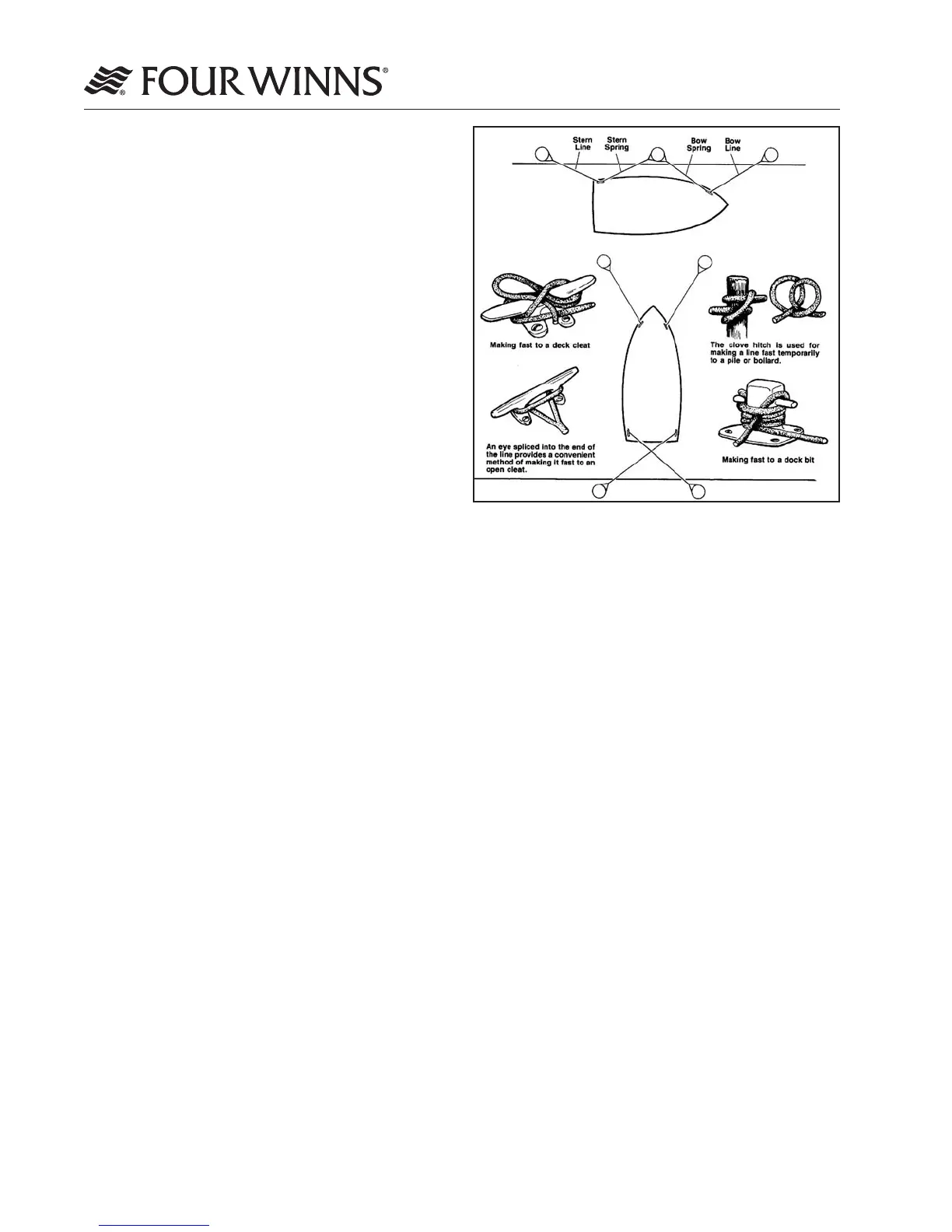
The mooring lines you will use most often are the
bow line, the stern line, and spring lines as shown
onFigureT-6.Eachlinehasaspecicpurpose.The
bow line and the stern line secure your boat’s bow
and stern. The two spring lines keep your boat from
moving forward or backward when you are moored
alongside a dock.
Figure T-6: Mooring Lines
If you are mooring your boat for a short time, bow and
stern lines may be the only lines you will need. If you
are mooring your boat for a longer time or the currents
are swift, you should use spring lines. The stern spring
line leads from the boat’s stern cleat forward to the
piling or cleat on the dock. The bow spring line leads
from the bow cleat aft to the dock.
If you are mooring your boat in a slip, bow and
spring lines, port and starboard, will keep your boat
in position.
NOTE: If tides are a consideration, be sure to leave
slack in the lines to make up for the rise and fall of the
water while your boat is docked.




 To Next Page