Owner’s Manual Page 25Boating Safety - Section B
3. Teach children how to put a PFD on and allow
them to try it in the water. That way, they know
what the PFD is for and how it works. They will
feelmorecomfortablewithitiftheysuddenlynd
themselves in the water.
4. If the PFD is wet, allow it to dry thoroughly
before storing it. Do not dry it in front of a radiator
or heater. Store it in a well ventilated area.
5. Keep PFDs away from sharp objects which can
tearthefabricorpuncturetheoatationpads.
6. For their own safety and the safety of others, all
nonswimmers, poor swimmers, and small children
should wear PFDs at all times, whether the boat
is stationary or moving.
7. Check the PFD frequently to make sure that it is
nottorn,thatotationpadshavenoleaks,andthat
all seams and joints are securely sewn.
8. IfaPFDcontainskapok,thekapokbersmay
become waterlogged and lose their buoyancy
after the vinyl inserts are punctured. If the kapok
becomes hard or if it is soaked with water,
replace it. It may not work when you need it.
E. Fire Extinguisher
As the owner/operator of the boat, you are responsible
forsupplyingareextinguisherapprovedbytheUS
Coast Guard.
Hand-held portable extinguisher(s) should be mount-
ed in a readily accessible location(s) away from the
engine compartment. All persons aboard should
knowthelocation(s)andproperoperationofthere
extinguisher(s).
FIRE
In case of re do not open the engine compart-
ment. Shut down engine(s), generator(s), and
blower(s). Discharge entire contents of xed
re suppression system, if equipped. If using
a portable CO2 re extinguisher, continuously
discharge entire contents. On European mod-
els, discharge contents through re port.
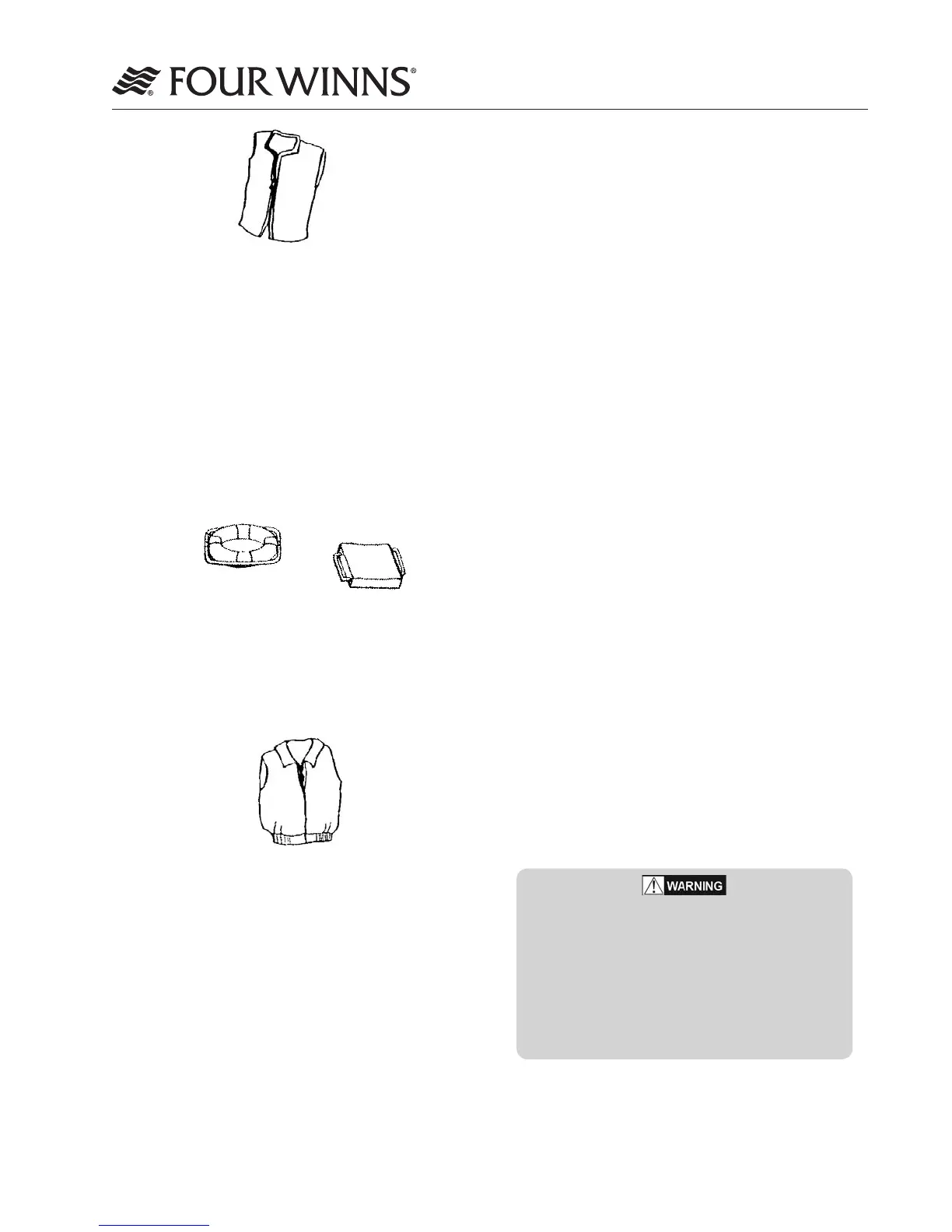
Figure B-3: Type III, Wearable
PFD Type IV, Throwable (Figure B-4) is required
in addition to the PFDs previously discussed. The
most common Type IV PFD is a buoyant cushion or
ring buoy. It is designed to be thrown to a person in
the water, grasped and held by the user until he or
she is rescued. A Type IV PFD should always be in
serviceable condition and immediately available for
use.GraspingthisPFDmaybedifcultiftherescue
is delayed or if the user is overcome by hypothermia
(loss of body heat).
Figure B-4: Type IV, Throwable
PFD Type V, Wearable (FigureB-5)wheninated,it
provides buoyancy equivalent to Type I, II, or III PFDs.
Whenitisdeated,however,itmaynotsupportsome
people.
Figure B-5: Type V, Wearable
D. PFD Pointers
The purpose of a PFD is to help save your life.
If you want it to support you when you are in the
water,itneedstot,oat,andbeingoodcondition.
1. TrythePFDonandadjustituntilittscomfortably
in and out of the water. Mark your PFD if you are
the only wearer.
2. To make sure the PFD works, wear it in the water.
This will show you how it works and give you
condencewhenyouuseit.




 To Next Page