Owner’s Manual Page 72Fuel Systems - Section I
Figure I-3: Fuel Sender Operation
Due to the mechanical nature of the fuel sender,
variations in readings during various speeds of
operation may occur. This system is merely a relative
indication of the available fuel supply and not a
calibrated instrument. With this type of sending unit
a more accurate measurement of fuel level is obtained
with the boat in a level position.
The gauge readings will also vary with the trim angle
of the boat. When sitting at a dock and the boat is
nearly level, the fuel gauge will register accurately.
Refer to Figure I-3. When boating, the trim angle of
the boat changes and affects the gauge readings.
Under these conditions, the fuel sender will register
“full”fortherstfewhoursofrunningtimeuntilthefuel
level drops below the 3/4 or 1/2 mark. This is caused
by the angle of the fuel in the tank as shown in
Figure I-4.
Figure I-4: Effects of Trim Angle
It is very important to keep track of hours and fuel
consumption to obtain an average gallon per hour
consumptiongure.Refertothefuelloglocatedat
the back of this manual. This will help to prevent any
problems with running out of fuel on the water.
Dealersareequippedwithsomegeneralgureson
consumption which can be used as a guide until spe-
cicinformationonyourboatisdetermined.Because
of boating conditions, speed, weight and other factors
common to your situation, fuel consumption will vary
betweenyourboatandconsumptionguresdevel-
oped by Four Winns.
C. Anti-Syphon Valves
The fuel withdrawal line is equipped with an anti-
s
yphon valve where the line attaches to the fuel tank.
This valve prevents gasoline from syphoning out of
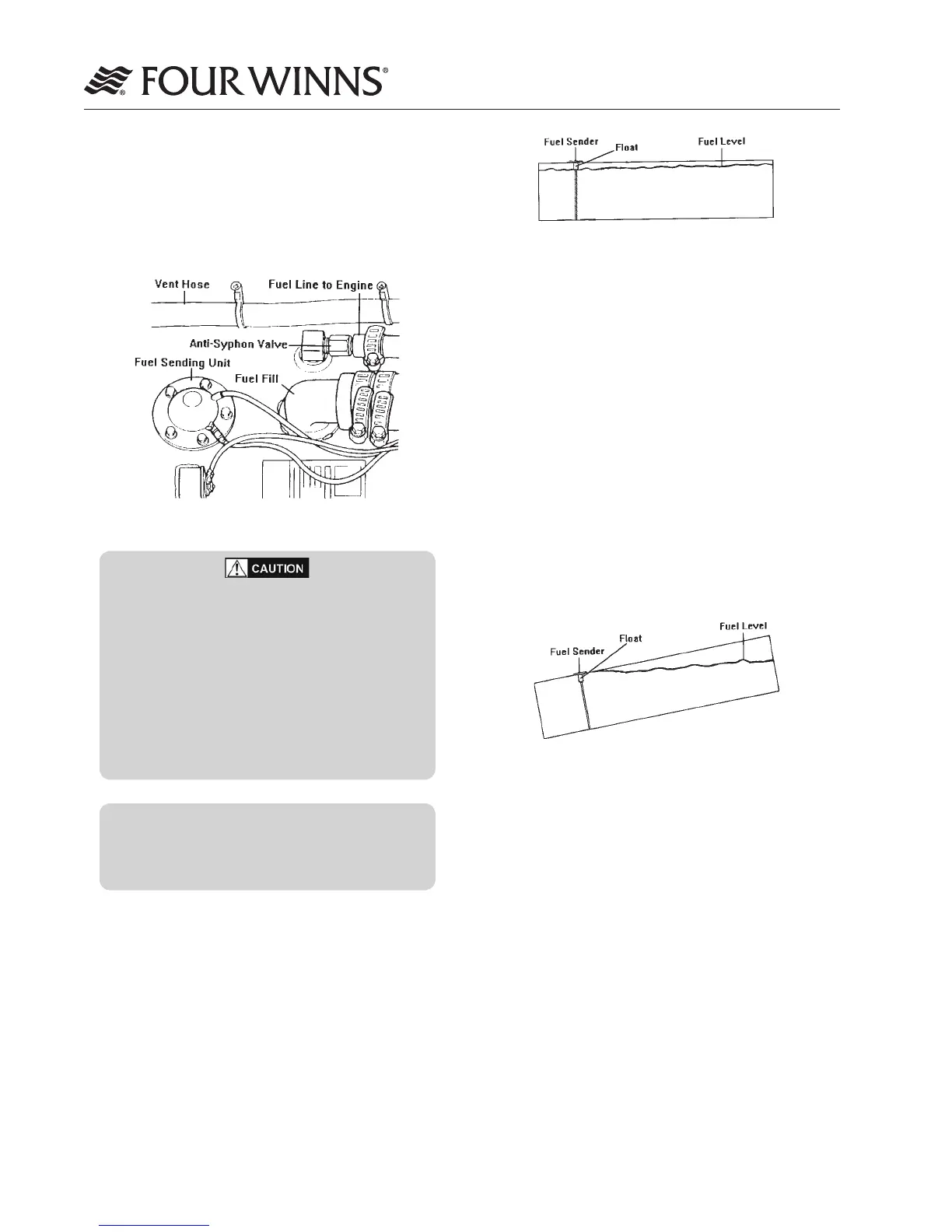
the fuel tank should a line rupture. See Figure I-2 for
anti-syphon location.
Figure I-2: Fuel Tank Fittings
The fuel withdrawals are positioned in the fuel
tanks to achieve optimum fuel usage, and fuel
line routing. At certain speeds and hull trim
angles, the fuel supply at the withdrawal tank
location can increase or decrease accord-
ingly. Be extremely careful when attempting to
operate the boat on a minimum amount of fuel.
Though some fuel may be in the tank, the rela-
tive trim angle of the boat may cause the fuel
to ow away from the withdrawal.
NOTICE
Access plates or lids are provided in the oor
for easier access to the fuel pick-up, anti-sy-
phon valve and sender.
D. Fuel Gauge
The fuel gauge indicates the amount of fuel in the
tank. See Section E-6F - Fuel Gauge (4-in-1-Gauge)
for additional information on fuel gauge use.
E. Fuel Senders
Thefuelsenderconsistsofaoatwhichtravelsup
anddownastationarytube.Theoatmeasuresthe
level of the fuel in the tank and sends a signal to the
fuel gauge. See Figure I-3.




 To Next Page