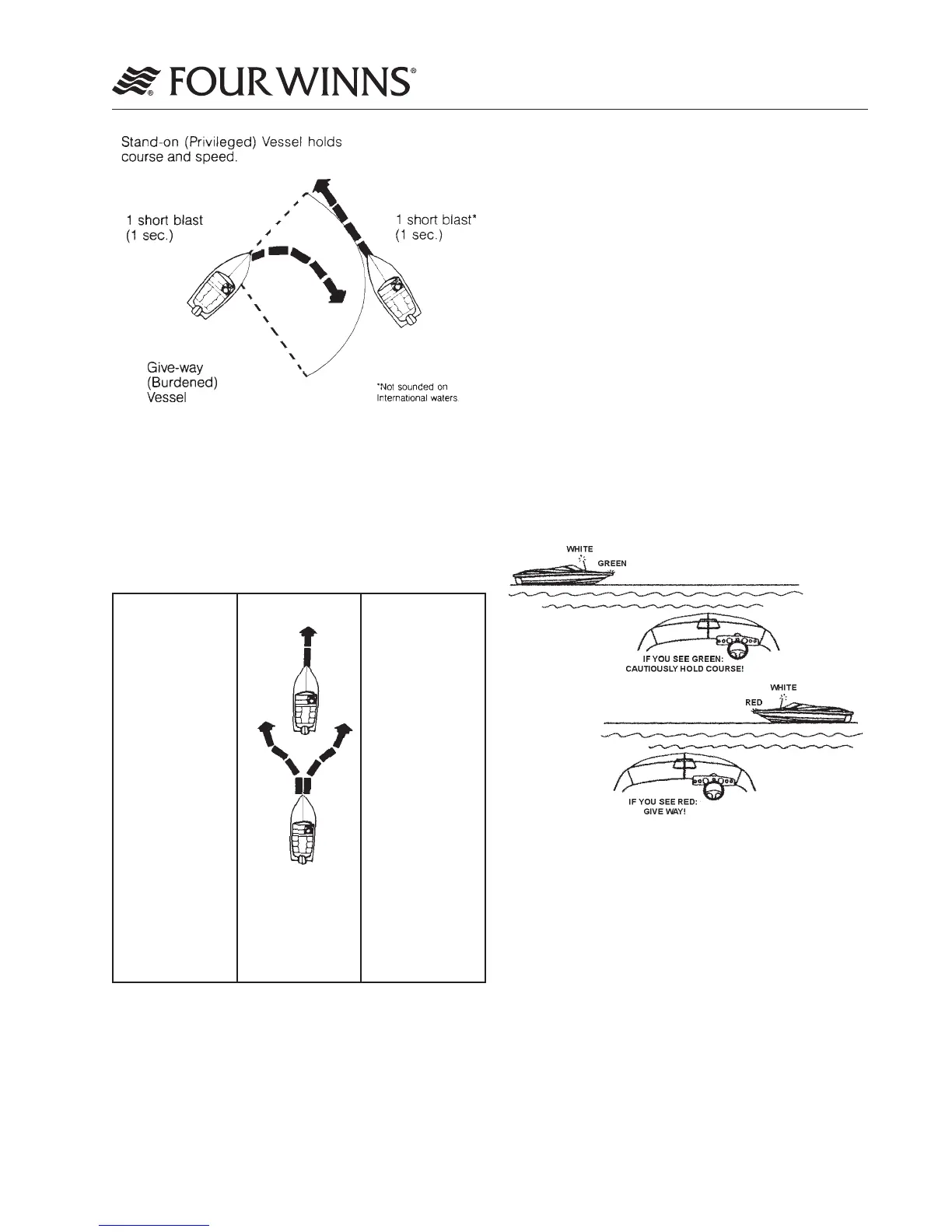
Owner’s Manual Page 39Basic Seamanship - Section C
Figure C-2: Crossing Situation
4. Overtaking
The boat overtaking the one ahead must yield the
right-of-way to the boat being passed. The overtaking
boat must make necessary adjustments to keep out of
its path. The boat being passed should hold its course
and speed. See Figure C-3.
Inland Rules
“I want to pass you on your
port side.
2 short blasts (1 sec.)
“Proceed”
2 short blasts (1 sec.)
International Rules
“I am altering my course to
port.”
2 s
hort blasts (1 sec.)
International Rules in
Narrow Channels
“I intend to pass you on
your port side.”
2 prolonged blasts (4-6
sec.)
2 s
hort blasts (1 sec.)
“Proceed.”
1 prolonged, 1 short
1 prolonged, 1 short
Stand-on (Privileged)
Vessel Being Overtaken
Give-way (Burdened)
Vessel Overtaking
Inland Rules
“
I want to pass you on your
starboard side.
1 short blast (1 sec.)
“Proceed”
1 short blast (1 sec.)
International Rules
“I am altering my course to
starboard.”
1 s
hort blast (1 sec.)
International Rules
in Narrow Channels
“I intend to pass you on
your
starboard side.”
2 prolonged blasts (4-6
sec.)
1 short blast (1 sec.)
“Proceed.”
1 p
rolonged, 1 short
1 prolonged, 1 short blast
Figure C-3: Overtaking
5. The General Prudential Rule
The general prudential rule regarding right-of-way is
that if a collision appears unavoidable, neither boat has
right-of-way. As prescribed in the “Rules of the Road”,
both boats must act to avoid collision.
6. Night Running
B
oats operating between sunset and sunrise (hours
vary by state), or in conditions of reduced visibility,
must use navigational lights. Nighttime operation,
especially during bad weather or fog, can be danger-
ous. All “Rules of the Road” apply at night, but it is
best to slow down and stay clear of all boats regard-
less of who has right-of-way.
To see more easily at night, avoid bright lights when
possible. Also, it is helpful to have a passenger keep
watch for other boats, water hazards, and naviga-
tional aids.
To determine the size, speed and direction of other
vessels at night, you should use running lights.
A green light indicates the starboard side, and the
red light indicates the port side. Generally, if you see
a green light, you have the right-of-way; if you see
a red light, give way to the other vessel.
See Figure C-4.
Figure C-4: Night Running
7. Whistle Signal
Out on the water, whistle signals are commonly
used. Although using a whistle signal is not neces-
sary every time a boat is nearby, operators must
signal their intentions when necessary to avoid
potentially confusing or hazardous situations. Use
whistle blasts early enough to be noticed and under-
stood by other boaters.
Itiscustomaryfortheprivilegedboattosignalrst
and the yielding boat to return the same signal to
acknowledge she understands and will comply.
Usethedangersignal(veormoreshortandrapid
Danger Zone
112.5
o




 To Next Page